▼ In This Article
Best Church Facility Management Software in 2026: Compare Scheduling, Maintenance, Rentals, and Event Operations
Search “church facility management software” and you will find a dozen roundups that all more or less rank the same ten tools against a single, vague “facility management” scorecard. The problem is that “facility management” is not really one job. A church trying to stop double-booking the fellowship hall has a different problem than a church trying to track HVAC preventive maintenance, and both are different from a church trying to manage weddings, external rentals, contracts, and deposits. Treating all three as the same shopping list is why so many churches end up with software that is a good fit for someone else.
This guide takes a different approach. Instead of one blended ranking, we score each tool across five distinct jobs: scheduling, maintenance and asset management, rentals and contracts, ChMS and Microsoft integration, and ease of adoption, so you can match software to the actual failure mode your church is dealing with. We also cover what is often missing from these roundups entirely: facility rental risk, insurance requirements, accessibility nuance, and the tax questions that come up once a church starts renting out space regularly.
A note on how we built this: pricing and feature details below reflect publicly available vendor information as of mid-2026. Vendor pricing and features change often, so confirm current details directly with each provider before making a decision.
What Is Church Facility Management Software?
Church facility management software helps churches schedule rooms and resources, approve facility requests, track maintenance, coordinate setup needs, and maintain visibility across ministries, campuses, and events, all in one system instead of scattered spreadsheets, email threads, and paper forms.
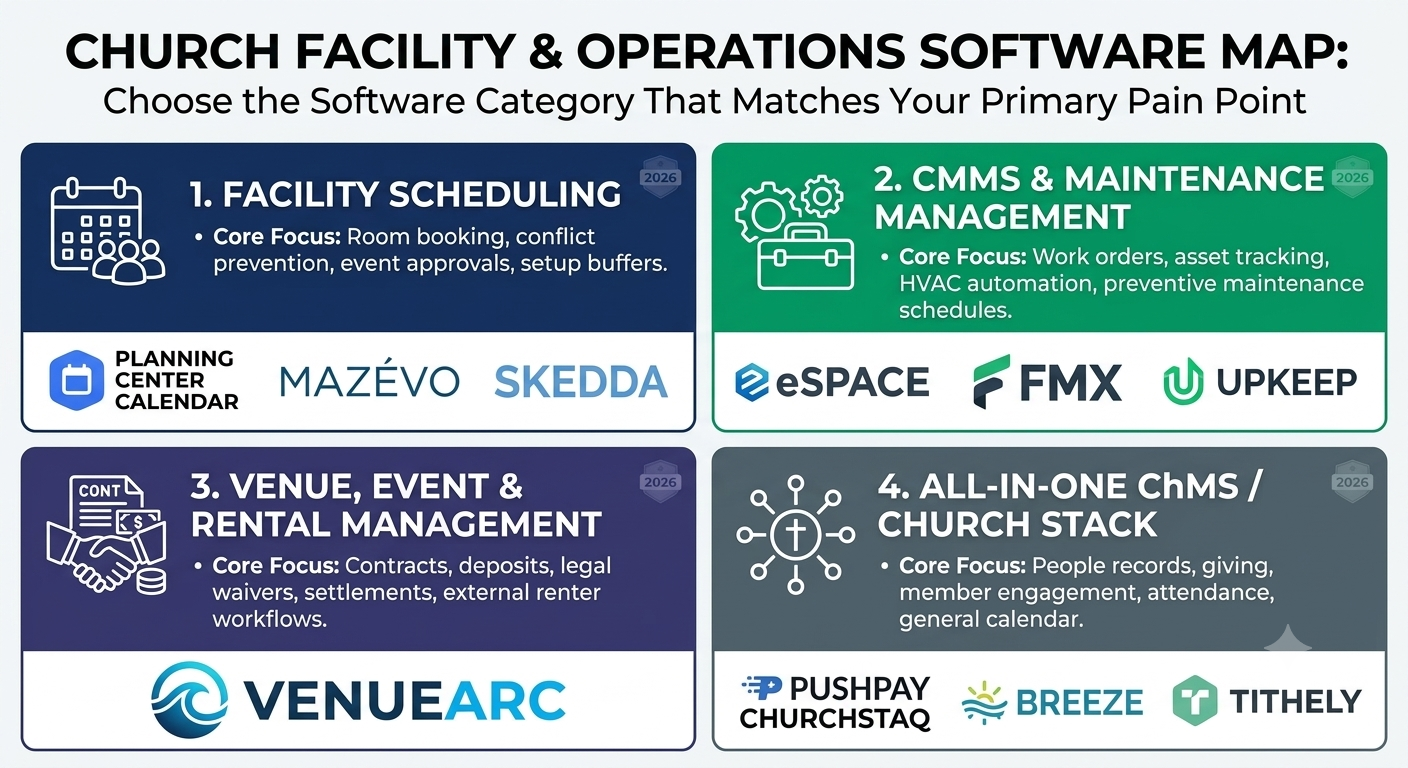
It is worth being precise about scope, because “church facility management software” gets used to describe several distinct categories:
- Facility scheduling software: room and resource booking, conflict detection, approvals, recurring events.
- CMMS (computerized maintenance management systems): work orders, preventive maintenance, asset tracking, inspections.
- Church management software (ChMS): member records, giving, attendance, communication, sometimes with a calendar module attached.
- Venue/event booking and rental software: event operations, contracts, deposits, settlements, and multi-space coordination, especially relevant once a church regularly rents space to outside groups.
Most churches actually need some combination of the first and either the second or fourth, rarely all of it from one vendor, and that is fine. Below, we sort the field by which job each tool does best.
Quick Picks
- Best overall for churches with complex event and rental operations: VenueArc
- Best for church work orders and preventive maintenance: eSPACE
- Best for churches already in the Planning Center ecosystem: Planning Center Calendar
- Best general-purpose facility and maintenance platform: FMX
- Best for room and resource scheduling with rental support: Mazevo
- Best budget-friendly, simple option: Breeze / Tithely
How We Evaluated the Tools
We scored each product across five jobs a church facility buyer is typically trying to solve:
- Facility scheduling: room and resource booking, conflict detection, recurring events, approvals.
- Work orders and assets: maintenance requests, preventive maintenance, asset and inventory tracking.
- Rentals, contracts, and payments: facility use agreements, deposits, invoicing, settlement.
- ChMS / Microsoft 365 integration: how well the tool fits into a church’s existing software stack.
- Ease of use and adoption: how realistic it is that staff and volunteers will actually use it consistently.
Comparison Table
| Software | Best for | Scheduling | Work orders/assets | Rentals/contracts | ChMS/Microsoft fit | Pricing model |
|---|---|---|---|---|---|---|
| VenueArc | Event booking, rentals, contracts, settlements | Strong | Not a focus | Strong | Azure-native, integration-friendly | Contact for pricing |
| eSPACE | Work orders + preventive maintenance | Strong | Strong | Limited | ChMS integrations available | Tiered, roughly $99-$275+/month by module |
| Planning Center Calendar | Planning Center churches | Strong (in-ecosystem) | Not included | Not a focus | Part of Planning Center suite | Free for 1 room; scales with room count |
| FMX | General facility + maintenance | Strong | Strong | Moderate | API-based integrations | Contact for pricing |
| Mazevo | Room/resource scheduling with rentals | Strong | Limited | Moderate | Calendar integrations | Contact for pricing |
| Pushpay ChurchStaq | Large churches wanting an all-in-one stack | Moderate | Not a focus | Limited | Deep ChMS integration | Contact for pricing |
| Breeze / Tithely | Small/mid churches, simple needs | Basic | Not included | Not a focus | Native ChMS ecosystem | Budget-friendly |
| ChurchSuite | UK/global churches | Strong | Limited | Moderate | Native ecosystem | Contact for pricing |
| ChurchTrac | Budget-conscious all-in-one ChMS | Basic | Not included | Not a focus | Native ecosystem | Affordable, entry-level |
| TouchPoint | Enterprise ChMS, large/multisite | Moderate | Not a focus | Limited | Deep ChMS integration | Contact for pricing |
| UpKeep | Maintenance-first teams | Not a focus | Strong | Not a focus | General CMMS, not church-native | Contact for pricing |
| Skedda | Simple space booking, non-church-specific | Moderate | Not included | Not a focus | Microsoft 365/Google Workspace integration | Contact for pricing |
Detailed Reviews
VenueArc - Best for Event Booking, Rentals, and Contract-Heavy Operations
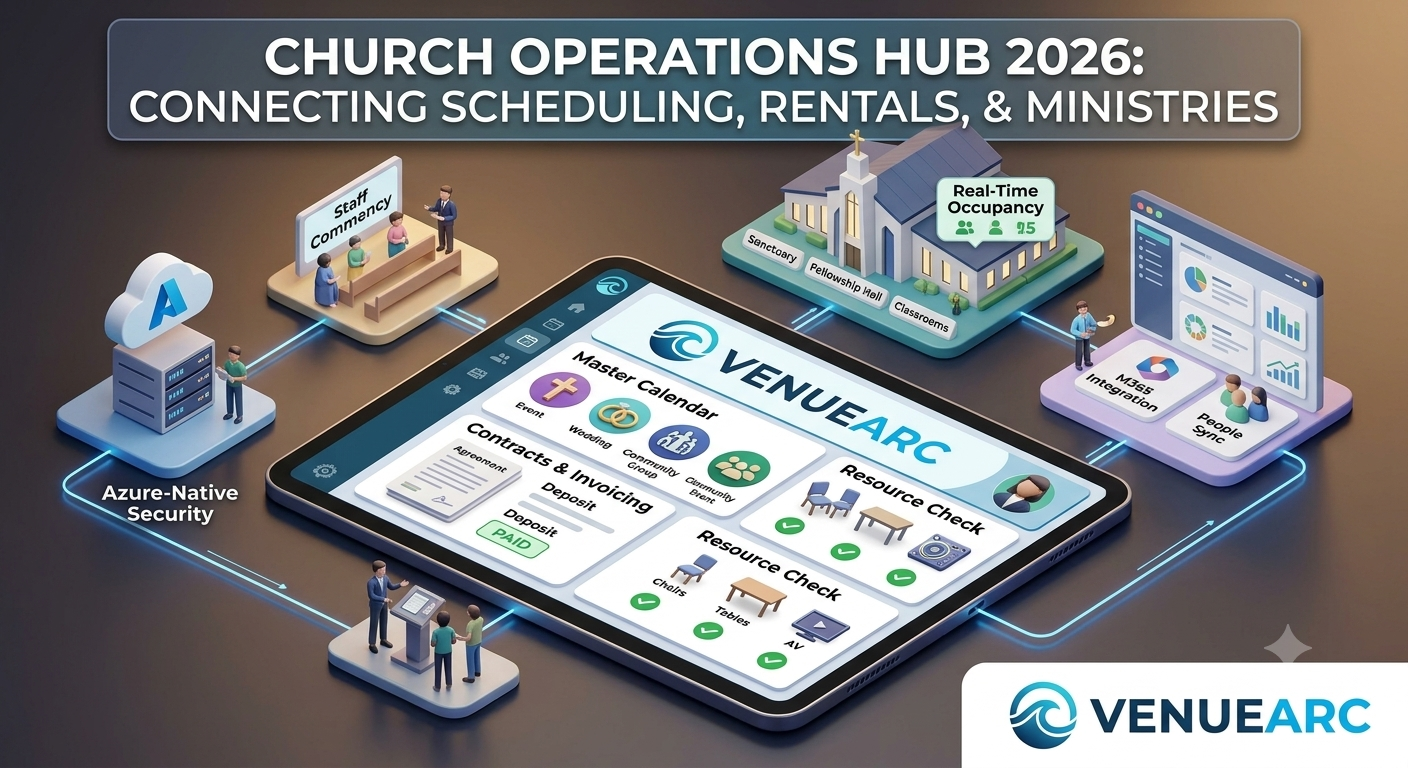
VenueArc is a venue management platform built around booking and calendar management, CRM, contract generation, an event portal, financial and settlement tracking, reporting, and permissions, delivered as Azure-based SaaS. For churches, that combination is the strongest fit when the real challenge is not just “who has the room” but the full lifecycle of an event or rental: agreement, deposit, setup, and financial reconciliation.
Strengths: Booking calendar and multi-space event coordination; contract generation and document workflows; financial visibility and settlement; role-based permissions; Azure-native security posture.
Where it is not the strongest fit: VenueArc is not built as a dedicated CMMS. If preventive maintenance, work orders, and asset lifecycle tracking are your church’s primary pain point, a tool like eSPACE or FMX will go deeper.
Best for: Churches and multi-space religious organizations that regularly manage weddings, funerals, and outside rentals alongside their own ministry calendar, and want booking, contracts, and financial reporting connected in one system.
eSPACE - Best for Work Orders and Preventive Maintenance
eSPACE, from Smart Church Solutions, is built specifically for churches and schools, with three core modules: event scheduling, work order and asset management, and HVAC/building-system integration. It offers real-time conflict detection, unlimited users on its plans, and integrations with several ChMS platforms and calendar tools.
Strengths: Strong maintenance and asset-management depth; church-specific design; building-automation integrations.
Pricing: Publicly listed rates place eSPACE around $99/month to roughly $275+/month depending on modules and tier. Confirm current pricing directly.
Best for: Churches whose primary pain point is maintenance backlog and asset tracking alongside room scheduling.
Planning Center Calendar - Best for Planning Center Churches
Planning Center Calendar is the facility-scheduling module inside the broader Planning Center ecosystem, covering room/resource booking, approval requests, conflict management, and a public-facing calendar.
Strengths: Deep integration with the rest of Planning Center; clear room-based pricing; strong church adoption.
Where it is not the strongest fit: It is a calendar and room-booking module, not a maintenance or asset-management system.
Best for: Churches already using Planning Center for people, giving, or services.
FMX - Best General-Purpose Facility and Maintenance Platform
FMX is a broader facility management platform (not church-exclusive) offering scheduling, work orders, preventive maintenance, inventory, and reporting, with API access for custom integrations.
Strengths: Highly configurable and general-purpose for larger or multi-site organizations.
Where it is not the strongest fit: More setup and configuration is typically required compared to church-native tools.
Best for: Larger churches or multi-site organizations that want a configurable platform and have staff capacity to configure it.
Mazevo - Best for Room/Resource Scheduling With Rental Support
Mazevo offers room and resource scheduling for churches and temples, including AV/furniture/catering coordination, public calendars, mobile access, and approval workflows.
Strengths: Strong day-to-day scheduling experience and resource-level detail.
Where it is not the strongest fit: Less maintenance/asset depth than dedicated CMMS platforms like eSPACE or FMX.
Best for: Churches and temples needing strong room and resource scheduling with straightforward rental support.
Pushpay ChurchStaq - Best for Large Churches Wanting an All-In-One Stack
Pushpay ChurchStaq includes room requests, facility approvals, room reports, and facility calendars as part of a broader engagement and ChMS ecosystem.
Best for: Large churches wanting facility workflows embedded inside a broader ministry stack.
Breeze / Tithely - Best Budget-Friendly, Simple Option
Breeze and Tithely offer basic room/location assignment with automatic conflict detection as part of affordable ChMS offerings.
Best for: Small to mid-size churches that mainly need to stop double-booking rooms without heavy complexity.
ChurchSuite - Best for UK and Global Churches
ChurchSuite offers resource usage reports, notifications, conflict detection, and setup/set-down buffers with strong adoption outside the U.S.
Best for: Churches outside the U.S. looking for an all-in-one ChMS with solid facility-booking features.
ChurchTrac - Worth Considering for Budget-Conscious Churches
ChurchTrac is an affordable all-in-one ChMS with event tools and strong adoption among smaller churches.
Best for: Very small churches prioritizing affordability over facility-specific depth.
TouchPoint - Best for Enterprise, Multi-Site Churches
TouchPoint is an enterprise-oriented ChMS with strong workflow and integration capabilities.
Best for: Large churches that can pair enterprise ChMS with a dedicated facility tool.
UpKeep - Worth Considering for Maintenance-First Teams
UpKeep is a general-purpose, mobile-first CMMS built around maintenance requests, asset tracking, and preventive maintenance.
Best for: Churches with dedicated facilities teams whose primary need is maintenance.
Skedda / CalendarWiz - Worth Considering for Simple Space Booking
Skedda and CalendarWiz are general-purpose space booking tools integrating with Microsoft 365 and Google Workspace.
Best for: Churches wanting simple, non-church-specific room booking.
Facility Scheduling vs. Church Management Software vs. CMMS
- If your problem is “we do not know who has the room,” you need facility scheduling.
- If your problem is “our building keeps breaking and no one is tracking it,” you need a CMMS.
- If your problem is “we cannot manage the people side of ministry,” you need a ChMS.
- If your problem is “we run weddings, rentals, and complex events and need contracts/deposits/financial visibility,” you need venue-style event and rental management.
How to Choose by Church Size and Use Case
- Small church, one or two rooms, occasional conflicts: Breeze, Tithely, or Planning Center Calendar free tier.
- Mid-size church with growing ministries and occasional rentals: Mazevo or Planning Center Calendar.
- Church with aging facilities or a dedicated maintenance team: eSPACE or FMX.
- Church with frequent weddings/funerals/outside rentals generating revenue: VenueArc.
- Large or multi-site church wanting one connected ecosystem: Pushpay ChurchStaq or TouchPoint, often paired with a dedicated facility tool.
Implementation Checklist
- Map every space and resource before software configuration.
- Define request types and approval rules clearly.
- Document setup and teardown needs for recurring event types.
- Test for conflicts across rooms and resources before go-live.
- Confirm rental and maintenance requirements match actual product capabilities.
- Pilot with one ministry or department before church-wide rollout.
- Review utilization and adoption after 60-90 days and adjust.
Risk, Rentals, Insurance, Accessibility, and Tax Considerations
- Facility-use agreements and insurance: Require signed facility-use agreements, a certificate of insurance, and additional insured status where needed.
- Tax treatment of rental income: Rental income from real property is generally excluded from UBTI, but exceptions apply.
- ADA and accessibility: Religious entities are generally exempt from ADA Title III, but state/local requirements and non-religious tenant scenarios can change obligations.
- Fire and life-safety records: Track occupancy, egress, inspections, alarms, sprinklers, and extinguisher maintenance alongside scheduling.
None of the above is legal or tax advice. It is a starting point for questions to bring to your attorney, insurance advisor, and CPA.
Key Takeaways
- “Church facility management software” spans four categories: scheduling, CMMS/maintenance, ChMS, and venue/rental management.
- Most churches need a combination of tools, not one all-in-one platform.
- VenueArc is strongest when the primary challenge is event booking, external rentals, contracts, and financial settlement.
- eSPACE and FMX lead for maintenance and asset tracking; Planning Center Calendar leads for churches already in that ecosystem.
- Blackbaud Church Management was discontinued as of January 22, 2024, and churches still on it should plan migration.
- Facility rentals bring legal, insurance, and tax considerations (facility-use agreements, COIs, UBTI, ADA nuance) that should be handled alongside software selection.
- Successful rollout usually follows the same path: inventory, approval rules, setup documentation, conflict testing, pilot, and a 60-90 day review.
Book a Church Facility Workflow Review
Choosing software is easier once you know which job you are solving: scheduling, maintenance, or event and rental operations. If your church regularly manages weddings, external rentals, contracts, and deposits alongside your everyday ministry calendar, that is the specific problem VenueArc is built around.
See how VenueArc handles multi-room event requests, contracts, deposits, and settlement in one workflow.
Frequently asked questions
- What is the best church facility management software in 2026?
It depends entirely on the problem you are solving. VenueArc is the strongest fit for churches with complex event booking, rentals, and contracts. eSPACE leads for work orders and preventive maintenance. Planning Center Calendar is the best fit for churches already in that ecosystem.
There is no single best product because these tools solve genuinely different problems that happen to share a category name. A church whose main pain is deferred maintenance and a church whose main pain is rental administration will reach opposite conclusions from the same evaluation — and both will be right.
The most useful first step is naming the specific failure you want to stop: double-booked rooms, unbilled rentals, missed maintenance, or an office bottleneck. That answer narrows the field faster than any feature comparison.
- What's the difference between church facility management software and church management software?
Facility management software focuses on physical spaces — scheduling, maintenance, and rentals. Church management software focuses on people — member records, giving, attendance, and communication.
The overlap that causes confusion is that most church management platforms include a calendar. It is genuinely useful for publishing what is happening, and churches reasonably assume it covers scheduling. The gap appears at the operational layer: resource-level conflict checking, approval routing, setup requirements, and rental documentation.
Most churches end up running both, and that is a reasonable outcome rather than a failure of planning. The problems are different enough that few products handle both well, and trying to force one system to cover everything usually means accepting something inadequate on one side.
- What's the difference between facility scheduling software and a CMMS?
Facility scheduling software manages who uses which room and when. A CMMS manages work orders, preventive maintenance, and asset tracking. Many churches need both, sometimes from different vendors.
The two are more connected in practice than the definitions suggest, which is why the split causes problems. A room closed for floor refinishing is a maintenance fact with an immediate scheduling consequence, and if the two systems do not talk, the room stays bookable while it is unusable.
Which one you need first depends on where failures are actually costing you. Churches with ageing buildings and reactive repairs usually get more from a CMMS. Churches with contested spaces and active rental programmes usually get more from scheduling — and adding the other later is normal rather than a sign of poor selection.
- Which software is best for church facility rentals?
VenueArc and Mazevo both offer rental-friendly features. VenueArc goes further into contract generation and financial settlement, which matters most for churches with significant rental revenue.
The distinction becomes material once rentals stop being occasional. A handful of bookings a year can be handled with a template agreement and an invoice; a steady rental programme generates a continuous stream of agreements, deposits, balances, and documentation that has to be tracked against each booking.
That is usually where churches feel the gap. The scheduling side works, but nobody can say which upcoming rentals lack a signed agreement, which deposits are outstanding, or what facility income actually was last year — because the answers live across email, a spreadsheet, and one administrator’s memory.
- Can Microsoft 365 handle church room booking?
Basic room and equipment booking is possible through Outlook's room and equipment mailboxes and Scheduling Assistant, and Microsoft Lists can display dates in a calendar view. These generally lack the approval workflows, resource-level conflict detection, and rental features of dedicated facility software.
For churches already paying for Microsoft 365, it is a sensible place to start, and there is no reason to buy software to solve a problem the existing stack handles. Room mailboxes prevent the simplest double-bookings automatically.
The limits show up around the edges of a booking rather than the booking itself: setup and teardown buffers, approval that depends on event type rather than availability, and outside rentals needing agreements and insurance tracked alongside the reservation. Churches using this approach typically keep a parallel spreadsheet for exactly those gaps.
- Does church rental income create UBTI?
Rental income from real property is normally excluded from unrelated business income tax, but exceptions can apply — for example, where substantial services are provided to the renter. A CPA familiar with nonprofit taxation should be consulted.
This is worth understanding at a general level precisely because the exceptions are easy to trip without noticing. The distinction often turns on what the church provides alongside the space, and arrangements that feel like ordinary hospitality can change how income is characterised.
The practical implication for facility management is record-keeping. Whatever the tax treatment turns out to be, you need a clear record of what was rented, to whom, on what terms, and what was provided — and reconstructing that from email after the fact is considerably harder than capturing it on the booking.
- Are churches exempt from ADA requirements?
Religious entities are generally exempt from ADA Title III, but that exemption does not automatically extend to non-religious tenants using the space, and state or local building codes may still apply.
The tenant point is the one most often missed. A church may be exempt in its own operations while a commercial or community organisation renting the space is not, which means accessibility obligations can attach to a facility through its rental activity rather than its own use.
State and local codes are the other common surprise, since they operate independently of the federal exemption and vary considerably. Beyond compliance, accessibility is worth treating as a facility question in its own right — a congregation that cannot reach a room is excluded regardless of what the law requires. Confirm your specific obligations with counsel.
- Where does VenueArc fit compared with eSPACE, Planning Center, and FMX?
VenueArc is strongest for churches whose core challenge is event booking, external rentals, contracts, and financial settlement. eSPACE and FMX lead on maintenance and asset management, while Planning Center leads for churches already in that ecosystem who mainly need room scheduling.
These are complements as much as competitors, and the honest framing is that they optimise for different failure modes. A church losing money to unbilled rentals and a church losing money to deferred maintenance are not shopping for the same product.
Ecosystem fit deserves real weight too. A church already running Planning Center for people, giving, and services gains something from keeping scheduling alongside it, and that integration advantage can outweigh a stronger standalone tool — unless rentals and contracts are central, which is where the ecosystem option runs out of room.
Want technology done right?
Get a free assessment from an Inc. 5000 Microsoft Solutions Partner.
Get Free Assessment ->