Faster Agreement Creation
Templates with booking data auto-fill generate contracts in minutes, not hours.
CONTRACT MANAGEMENT
No more chasing signatures. No more lost agreements. No more guessing contract status.
Contract Operations Without Friction
Purpose-built contract workflows for high-volume venue and facility teams.
The Problem
These issues compound quickly as rentals and events scale.
Manual Word documents for every new booking.
Email back-and-forth delays waiting for signed copies.
Missing signatures with no status visibility.
Lost agreements across inboxes and shared drives.
Inconsistent template versions between staff and locations.
Forgotten deposits, due dates, and outstanding balances.
Disputes over terms with no single source of truth.
Contracts, invoices, and booking details split across tools.
Why Teams Move Contracts Into VenueArc
Templates with booking data auto-fill generate contracts in minutes, not hours.
Automation removes repetitive editing and manual status chasing.
Dates, spaces, pricing, and client details flow from booking records.
E-signatures and real-time tracking compress send-to-signed time.
Centralized records and signature history support audit readiness.
A modern contract process reflects your brand and reduces friction.
Interactive Feature Console
Select a capability to preview how teams use it in daily operations.
3x faster setup
Standardize facility rental, vendor, and event contracts so every agreement starts from an approved baseline.
How Contracts Management Works in VenueArc
Start from the reservation.
Use the right contract type for the scenario.
Dates, spaces, pricing, deposits, and client info populate instantly.
Deliver for secure e-signature directly from VenueArc.
Monitor draft, sent, viewed, signed, and expired at a glance.
Keep signed contracts connected to invoices, deposits, and settlements.
This Is What It Actually Looks Like
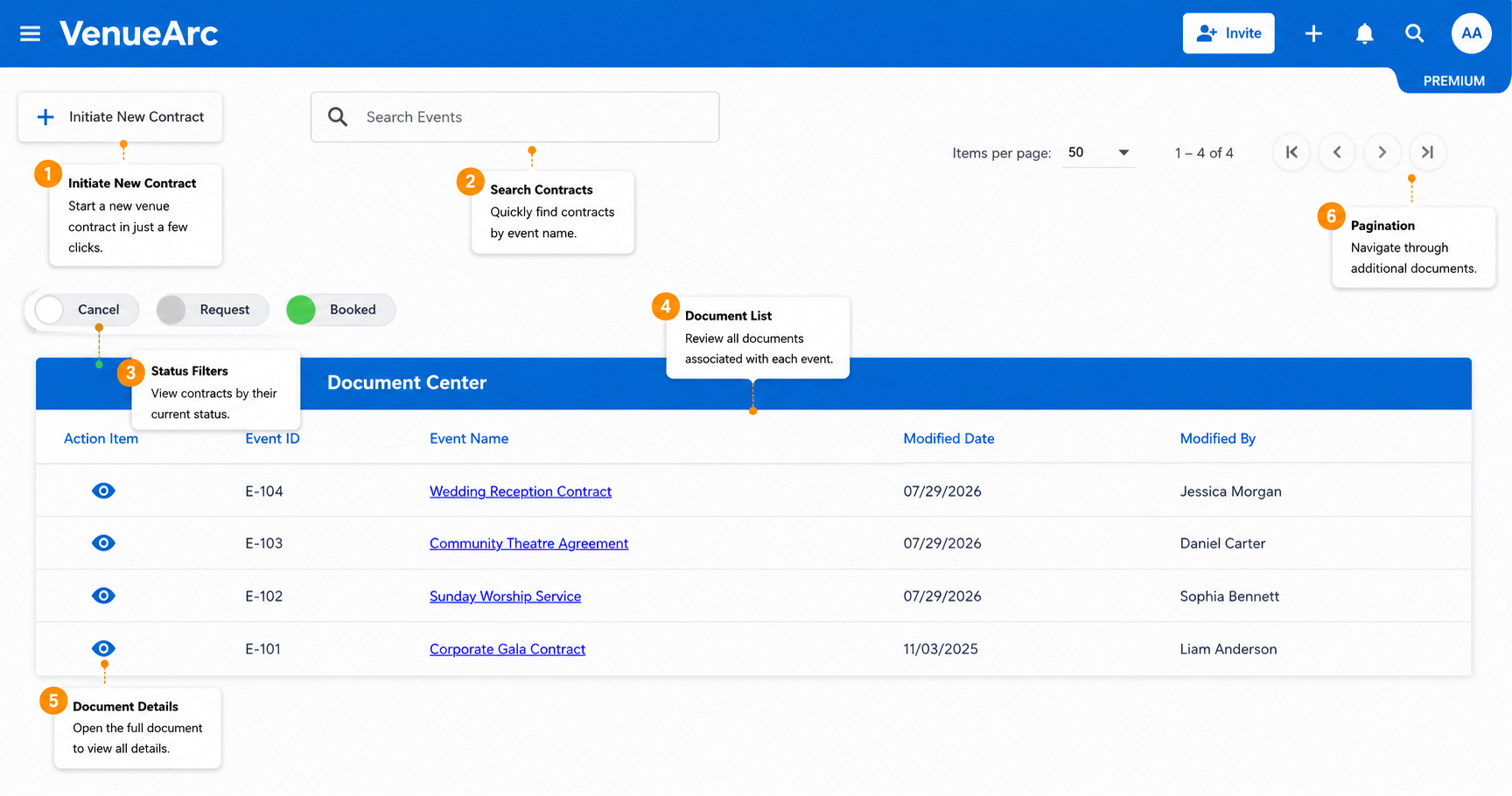
Contracts Management for Every Type of Venue
Standardize rental agreements for performance spaces, rehearsal rooms, and production resources with clear signature and deposit tracking for every show.
Standardize contracts for weddings, outside groups, and community events regardless of who submits the booking.
Manage recurring rental contracts for fields, pavilions, and community spaces with less manual work.
Keep class, private-event, and rental contracts connected to each booking instead of scattered files.
Apply consistent terms across event types while maintaining a complete audit trail for each agreement.
Generic Tools and Spreadsheets vs. VenueArc
| Generic Tools and Spreadsheets | VenueArc Contracts Management |
|---|---|
| Can sign documents but do not understand bookings | Contracts are a native extension of booking operations |
| Manual re-entry of event and pricing data | Auto-filled data comes from reservation records |
| Status and deposits tracked across separate systems | Status, signatures, deposits, and storage in one platform |
| Signed files disconnected from reservation records | Complete, auditable lifecycle from draft to signed |
Venue contract management software helps you create, send, sign, and store rental agreements and event contracts, linking each one directly to the booking it governs.
The linking is what separates it from simply keeping documents in a shared drive. A rental agreement is not a standalone file — it defines what a client is paying, which space they have, what deposit is held, and what happens if they cancel. When that document sits in a folder disconnected from the booking, answering a simple question means opening two systems and hoping they still agree.
Contract management software keeps the agreement attached to the event, so the terms travel with the booking. Staff checking a reservation can see whether it is under contract, whether it has been signed, and what was actually agreed, without going looking for the paperwork.
Yes. Templates auto-populate with dates, spaces, pricing, deposits, and customer information drawn from the booking itself, so agreements are not retyped for every rental.
Manual contract preparation is slow, but the bigger cost is inconsistency. When each agreement is assembled by copying the last one, small errors propagate — an old date left in the header, pricing that no longer matches what was quoted, a deposit clause that was updated in some copies but not others. These usually surface at the worst possible moment, when a client disputes a charge.
Generating from a template means the commercial terms come from the booking record rather than someone's memory or an earlier document. Every agreement uses the current approved wording, and the details in it match what the client was actually quoted.
Yes, with live status updates from sent to signed, so you can see exactly where each agreement stands without chasing anyone.
Electronic signing removes the slowest and least predictable step in the rental process. The traditional alternative — print, scan, email, wait — introduces delay at precisely the point where a booking is still not commercially secure. A space sits provisionally held while paperwork moves at the pace of whoever last had access to a scanner.
The visibility matters as much as the signing. Knowing that a contract was sent tells you little; knowing it was opened but not signed tells you whether to follow up, and knowing it is complete tells you the booking is confirmed. That status is visible on the booking itself, so the team can act on it without asking whoever sent the agreement.
Yes. Contracts move through clear states — draft, sent, viewed, signed, and expired — so teams always know what the next action is.
Without explicit status, contract chasing becomes guesswork built on inbox archaeology. Someone searches sent mail to work out whether an agreement went out, cannot tell whether the client ever opened it, and either follows up on something already signed or lets a genuinely stalled contract sit untouched for a fortnight.
Distinct states make the pipeline visible at a glance. Sent but not viewed may mean the email went astray. Viewed but not signed usually means the client has a question. Expired means the space should probably be released. Each state implies a different action, which is what turns contract tracking into a routine rather than a periodic scramble.
Contracts live inside the booking record, connected to the related events, clients, settlements, and invoices rather than stored as separate documents.
This connection is what keeps the commercial and operational sides of an event consistent. The booking knows which space and date; the contract knows what was agreed and for how much; the settlement knows what was actually invoiced and paid. When these live in separate systems, reconciling them is manual work that typically happens only if someone raises a query.
Because they share one record in VenueArc, the chain is traceable in both directions. From a booking you can see its agreement and payment status. From a contract you can see the event it governs and whether it has settled. Nothing needs cross-referencing by hand, and there is no version of the truth that only exists in a filing cabinet.
Yes. Churches can standardize contracts for weddings, outside groups, and community events using consistent templates rather than ad-hoc paperwork.
Facility rental is often where churches carry the most risk with the least process. Congregational use is informal and trust-based, which works well internally — but the same informality frequently extends to outside groups, where it should not. Agreements get made verbally, terms vary depending on who handled the request, and expectations around damage, insurance, cleanup, or alcohol are assumed rather than written.
Standard templates let the church set those terms once and apply them consistently, so a wedding party and a community group are held to the same clearly stated conditions. It also removes an awkward burden from staff and volunteers, who no longer have to negotiate terms case by case or explain why one group was treated differently from another.
Yes. Recurring contracts cover fields, pavilions, and community spaces with substantially less manual work than issuing agreements one at a time.
Park districts feel this problem more acutely than most venues because so much of their rental activity repeats on a seasonal cycle. A youth league books the same fields every weekend for an entire season; a community group takes the same pavilion monthly. Handling those as individual agreements means preparing near-identical paperwork dozens of times, and every one of those is an opportunity for terms to drift.
A recurring contract covers the full arrangement while remaining tied to each individual booking, so utilization and settlement still report accurately per date. When a season is extended or a rain-out reschedules a fixture, the agreement adjusts without the whole thing being reissued.
Yes. An audit trail covers edits and signature events, giving you a defensible record for accountability and compliance.
The value of this only becomes obvious when something is disputed. A client insists they were quoted a different rate; a board member asks who approved a discount; an auditor wants evidence that the signed terms were not altered afterwards. Without a change history, these questions come down to competing recollections, and the organization is usually the party that struggles to prove its position.
Recording what changed, when, and in connection with which signature events turns those disputes into a matter of record. It also has a quieter preventive effect: when edits are visibly tracked, terms are far less likely to be adjusted informally as a favour, which is how inconsistent pricing tends to take hold in the first place.
One platform. Every contract. No more signature delays.
Book a Demo