
▼ In This Article
How to Market Your Community Theatre: 8 Tips to Attract Bigger Audiences and More Bookings
A great performance deserves a full house. But for many community theatres, the hardest part isn’t putting on the show — it’s getting people to know it’s happening at all.
Whether you’re trying to attract more local promoters, touring acts, or simply more butts in seats, marketing your theatre well makes the difference between a half-empty house and a packed calendar. Below are eight practical, budget-friendly ways community theatres can market themselves more effectively — no big-agency budget required.
1. Study What Similar Theatres Are Doing
Before you spend a dollar on marketing, spend an hour on research. Look at 4–5 comparable venues in your area or region — similar size, similar programming — and pay attention to:
- What social channels they’re most active on
- The type of content they post (behind-the-scenes clips, ticket promos, cast interviews)
- How often they post, and how they engage with comments
You don’t need expensive tools for this. A quick scroll through their Instagram, Facebook, or newsletter sign-up page will tell you a lot about what’s working in your market — and where there’s a gap you can fill.
2. Build Relationships With Local Promoters and Touring Acts
Promoters and booking agents are often the fastest path to a fuller calendar. A promoter who trusts your venue will bring you performers, audiences, and repeat bookings — without you having to chase every opportunity yourself.
To build these relationships:
- Reach out directly to promoters who work with acts similar to what your venue hosts
- Make your booking process easy — a promoter who has to call three times just to check availability will look elsewhere
- Follow up after events. A quick thank-you and a request for feedback goes a long way toward turning a one-time booking into a repeat one

3. Invest in Real Theatre Photography
Photos sell your space before a single ticket does. Booking agents and performers often judge a venue’s professionalism by how it looks online — long before they ever walk through the door.
Prioritize photos that show:
- The stage from a performer’s point of view
- A full house during a live show (with permission, of course)
- Load-in areas, backstage space, and seating layout — practical details performers and promoters actually want to see
If a full photo shoot isn’t in the budget, even high-quality phone photos from your next sold-out night can go a long way.
4. Optimize for Local Search
If someone searches “theatre near me” or “[your city] performance venue” and your theatre doesn’t show up, you’ve lost a customer before they even knew you existed.
A few quick wins:
- Claim and complete your Google Business Profile — add photos, hours, and your address so you show up on local map searches
- Use location-based keywords on your website, like “community theatre in [city/region]”
- Keep your contact info consistent across your website, social pages, and any directory listings — inconsistent addresses or phone numbers actively hurt local search rankings
5. Partner With Local Influencers and Community Voices
You don’t need a celebrity influencer — a well-connected local blogger, arts reviewer, or community Facebook group admin can be just as valuable. Invite a few to an upcoming performance, give them a warm welcome, and let them share their experience with their audience.
The goal isn’t just ticket sales for one night. It’s building a network of people who talk about your venue when performers or promoters are looking for a place to book.
6. Make Your Booking Process Effortless
No amount of marketing will make up for a clunky, slow booking process. If a promoter has to email back and forth for days just to confirm a date, you’re losing bookings to venues that make it easier.
A venue booking system built for community theatres lets you:
- Show real-time availability instead of relying on back-and-forth emails
- Send and sign contracts digitally, without the delays of paper and mail
- Keep every booking, hold, and settlement detail in one place, so nothing falls through the cracks
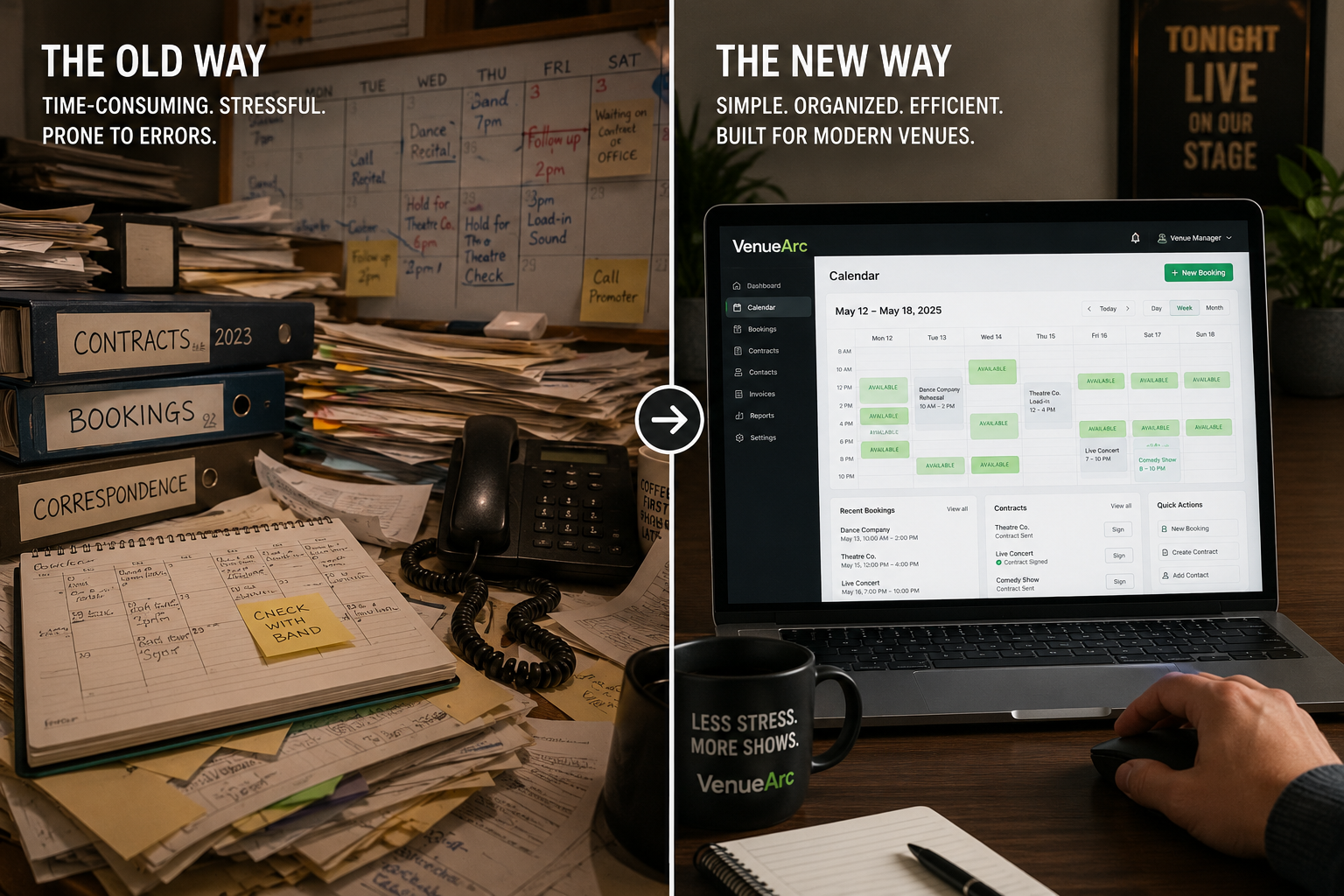
The easier it is to book your space, the more likely a promoter is to choose you over a competitor.
7. Keep Every Client Relationship Organized
Repeat bookings are the backbone of a healthy theatre calendar — but only if you’re actually tracking who’s booked with you before, what they need, and when to follow up.
A simple CRM built for venue and event management can help you:
- See a full history of every promoter, renter, and client at a glance
- Set reminders to follow up before a client’s usual booking season
- Avoid the awkward moment of forgetting a repeat client’s preferences
8. Treat Your Website Like Your Front Door
Your website is often the first — and sometimes only — impression a promoter, performer, or patron gets of your venue. Make sure it clearly answers the questions they’re actually asking:
- What does the space look like?
- What’s the seating capacity?
- How do I check availability or request a booking?
- Who do I contact, and how quickly will I hear back?
If your site makes people dig for this information, they’ll likely move on to a venue that doesn’t.
The Takeaway
Marketing a community theatre doesn’t require a massive budget — it requires consistency, the right local visibility, and a booking process that doesn’t get in your own way. Focus on making it easy for promoters, performers, and patrons to find you, trust you, and book with you, and a fuller calendar will follow.
Want to see how a purpose-built booking platform can support your theatre’s growth? Explore VenueArc’s venue booking software for community theatres.
Frequently asked questions
- How can a small community theatre market itself on a limited budget?
Focus on low-cost, high-impact tactics:
- Optimizing your Google Business Profile for local search
- Building relationships with local promoters who book acts like yours
- Using high-quality photos of your space
- Partnering with local influencers or community voices instead of paid celebrity endorsements
Photography is the most undervalued item on that list. Promoters and event organisers are choosing between venues they have often never visited, and poor photographs of a genuinely good space lose bookings to worse spaces that photograph well.
The common thread is that none of these require ongoing spend. A Google Business Profile, a decent set of images, and a handful of promoter relationships are largely one-time investments that continue producing enquiries.
- Why is local SEO important for a community theatre?
Most people search for venues using location-based terms such as “theatre near me” or “[city] performance venue.” If your theatre is not optimized for local search with a complete Google Business Profile and consistent contact information, you lose bookings and ticket sales to venues that appear first.
Consistency of contact information matters more than most theatres expect. Search engines cross-reference your name, address, and phone number across the web, and mismatches — an old address on a directory, a former phone number on a partner site — undermine confidence in the listing.
Community theatres are also unusually well placed to compete here. Local search rewards genuine local relevance, and a theatre with real community ties, reviews, and event history has advantages a commercial venue cannot easily buy.
- How do I attract more promoters and touring acts to my theatre?
Three things: build direct relationships with promoters who book acts similar to your programming, make your availability and booking process easy to access, and follow up after events to encourage repeat bookings.
Targeting matters more than volume. A promoter who books acts suited to your capacity and technical specification is worth far more than a broad outreach campaign, because the fit determines whether the relationship continues past one show.
Ease of booking is where community theatres most often lose to commercial venues, and it is entirely fixable. If a promoter has to email and wait two days to learn whether a date is free, they will book elsewhere — not because the venue is worse, but because they are working to a deadline and someone else answered first.
- Does booking software actually help with theatre marketing?
Indirectly, yes. A fast, easy booking process is often the deciding factor for promoters choosing between venues. Software that shows real-time availability and simplifies contracts removes friction that can otherwise cost you a booking, regardless of how strong your marketing is.
It is worth being clear about the mechanism: booking software does not generate demand. It protects the demand your marketing already created, which is a narrower but very real contribution.
The failure it prevents is a quiet one. A promoter enquires, the response takes three days because the person who knows the calendar was unavailable, and they book elsewhere without ever telling you why. Those losses never appear in any report, which is precisely why response speed is so consistently underestimated.
Want technology done right?
Get a free assessment from an Inc. 5000 Microsoft Solutions Partner.
Get Free Assessment ->