houses of worship
Church Facility Management Software: What Faith-Based Organizations Actually Need
How churches schedule sanctuaries, fellowship halls and classrooms across ministries, volunteers and outside renters without double bookings or spreadsheets.
IN THIS ARTICLE
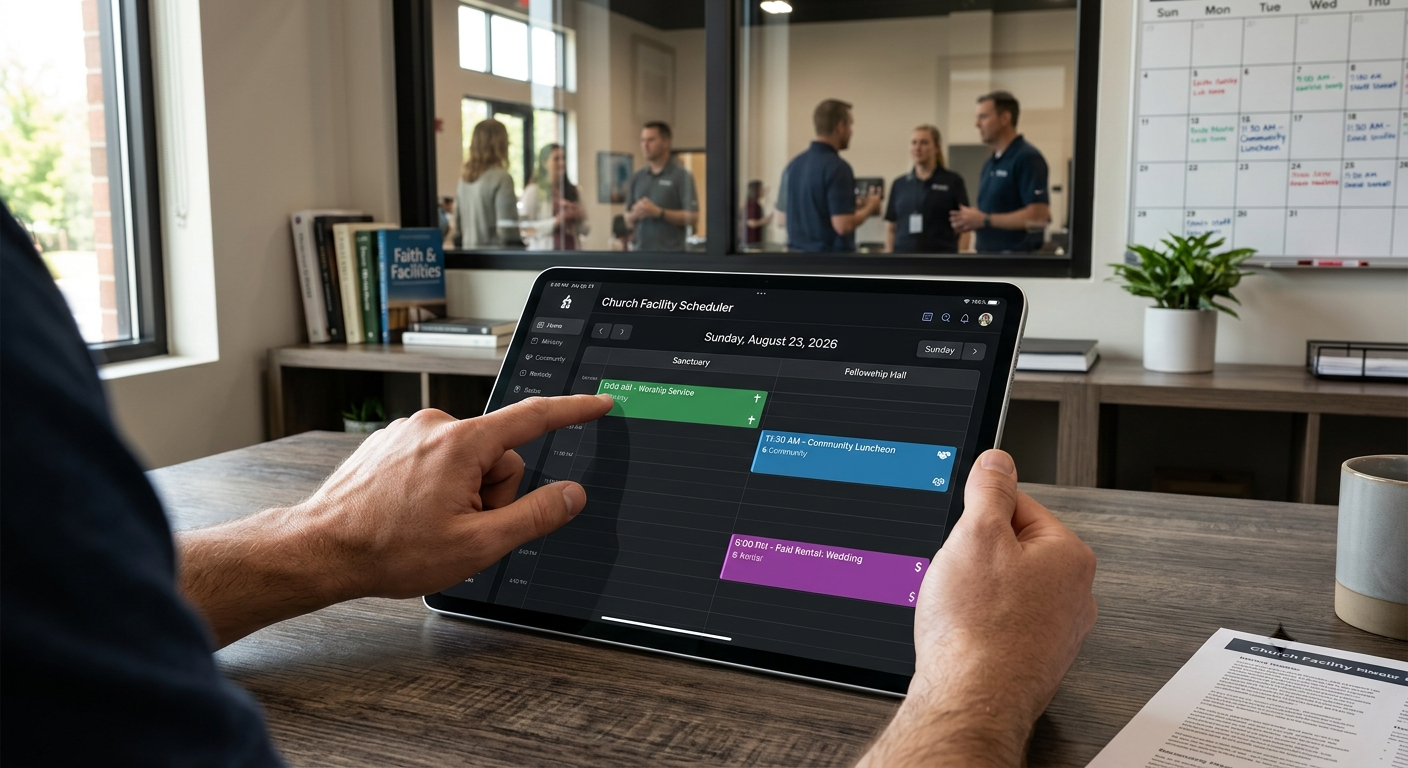
Church facility management software is a scheduling and operations system that lets a congregation book every room, service, ministry, and outside rental from a single calendar. It matters for churches, mosques, temples, and synagogues managing more than one bookable space.

This guide covers what the software must handle for faith-based organizations, what to look for before buying, and where a spreadsheet is still fine.
Key takeaways
- One space in a church is often used for ministry, internal events, and paid outside rentals.
- Recurring services need exception handling for dates like Ash Wednesday and Christmas Eve.
- Volunteer-heavy teams need role-based access and clear audit trails.
- Facility use policy enforcement requires workflow controls, not just documents.
Need help evaluating your workflow?
If your team is comparing booking tools, the most useful next step is a workflow-specific demo based on your actual requests, holds, and approval rules.
Book a DemoThe same physical space can serve incompatible purposes depending on the day. A sanctuary used for Sunday worship might host a rehearsal Tuesday and a community event Thursday. Each booking needs different approval and documentation.
A basic calendar treats all of these as the same type of event. A workable church scheduling process does not.
Ministry bookings, paid rentals, and community use are different
Most scheduling breakdowns happen because the calendar does not capture why a room is booked.
A workable system needs at least three categories:
- Ministry bookings
- Internal community use
- Paid external rental
Each category has different approvals, fees, and document requirements.
Recurring services and exception handling
Recurring schedules break when one-off exceptions are not handled properly.
A church calendar needs to support:
- One-time overrides
- Single-instance cancellations
- Temporary room reassignments
- Special-service staffing changes
Without this, staff revert to manual tracking during the busiest periods.
The volunteer permission problem
Churches run on volunteers. A front-desk volunteer, ministry lead, and administrator should not have identical access.
Role-based permissions matter for:
- Privacy
- Accountability
- Audit history
- Operational clarity
Per-facility pricing can also reduce pressure to share logins.
Facility use policy and insurance enforcement
A written facility use policy defines:
- Who can use the building
- What it costs
- What insurance is required
- Who gives final approval
Software should enforce this policy by attaching requirements, such as signed agreements and insurance certificates, directly to booking records.
Multi-campus and multi-site scheduling
For multi-campus churches, the scheduling question is no longer just room availability. It becomes governance:
- Which decisions are centralized?
- Which decisions stay local?
- How are shared resources coordinated?
| Scope | Typical need |
|---|---|
| Single campus, one building | Basic room coordination |
| Single campus, multiple buildings | Cross-space scheduling and approvals |
| Multi-campus | Central oversight with campus-level control |
Is renting church space right for your congregation?
Renting can create revenue and operational complexity at the same time. Software cannot make the values decision for the congregation, but it can make execution and tracking consistent.
Track decisions like:
- Which spaces are rentable
- Which groups are approved
- What pricing rules apply
- What documentation is required
Signing in with existing church identity systems
If your organization already uses Microsoft 365 tools, a scheduling platform that supports the same identity workflow can simplify onboarding and offboarding.
When church facility management software is overkill
A church with one room, low booking volume, and no outside rentals may still be fine with a shared calendar.
Dedicated software becomes worthwhile when:
- More than one space is managed
- Rental agreements or COIs are required
- Volunteer or staff turnover creates tracking gaps
Final decision point
If your church already experienced scheduling conflicts, the next step is not another spreadsheet tab. It is defining one booking workflow from request through confirmation, then implementing the right controls in one system.
VenueArc supports ministry bookings, external rentals, and operational governance in one calendar built for houses of worship.
Frequently Asked Questions
- What is church facility management software?
Church facility management software is a scheduling system that manages bookings across sanctuaries, classrooms, fellowship halls, and other spaces while separating ministry, internal, and external rental workflows.
- Does church scheduling software replace a shared Google Calendar?
Yes for churches managing multiple spaces or rentals. A shared calendar tracks busy/free, but dedicated software tracks approvals, insurance requirements, and contract status.
- How does church facility management software handle volunteer access?
It allows role-based permissions and individual logins so volunteers can access what they need without shared credentials.
- Can church facility management software manage multiple campuses?
Yes. Multi-campus setups need consolidated reporting across locations and controlled local access for each campus team.
- Do we need to require insurance from outside groups renting our building?
Most church insurers recommend requiring a certificate of insurance naming the church as an additional insured before use.
Ready to simplify your venue operations?
See how VenueArc helps venue teams coordinate bookings, approvals, documents, and settlement without routine operational chaos.