venue management
Event Management Platform vs. Software: Which Does Your Venue Actually Need?
Understand the difference between an event management platform and event management software, and decide what your venue actually needs.
IN THIS ARTICLE
The event technology industry uses “platform” and “software” almost interchangeably. Most of the time, that is harmless marketing language. But when you are choosing technology for a community theatre, house of worship, or park district, the distinction can matter because a true platform is usually designed to extend beyond a single application through integrations, APIs, and connected systems.
For most venue teams, however, the more important question is not what a vendor calls its product. It is whether the technology can handle your actual event lifecycle: request, hold, approval, booking, contract, event operations, payment, settlement, and reporting.
The terminology matters less than the architecture underneath it.
What is event management software?
Event management software is an application that helps organizations plan, schedule, coordinate, and manage events and the spaces, people, documents, and processes associated with them.
A venue might use event management software to:
- manage bookings
- coordinate event details
- route approvals
- manage contracts
- track payments
- store documents
- organize event logistics
- generate reports
For a community theatre, that might mean managing performance holds, rehearsal schedules, rental contracts, and settlement.
For a church, it might mean managing recurring services, ministry bookings, outside rentals, and room access.
For a park district, it might mean coordinating facility requests, approvals, permits, and public reservations.
What is an event management platform?
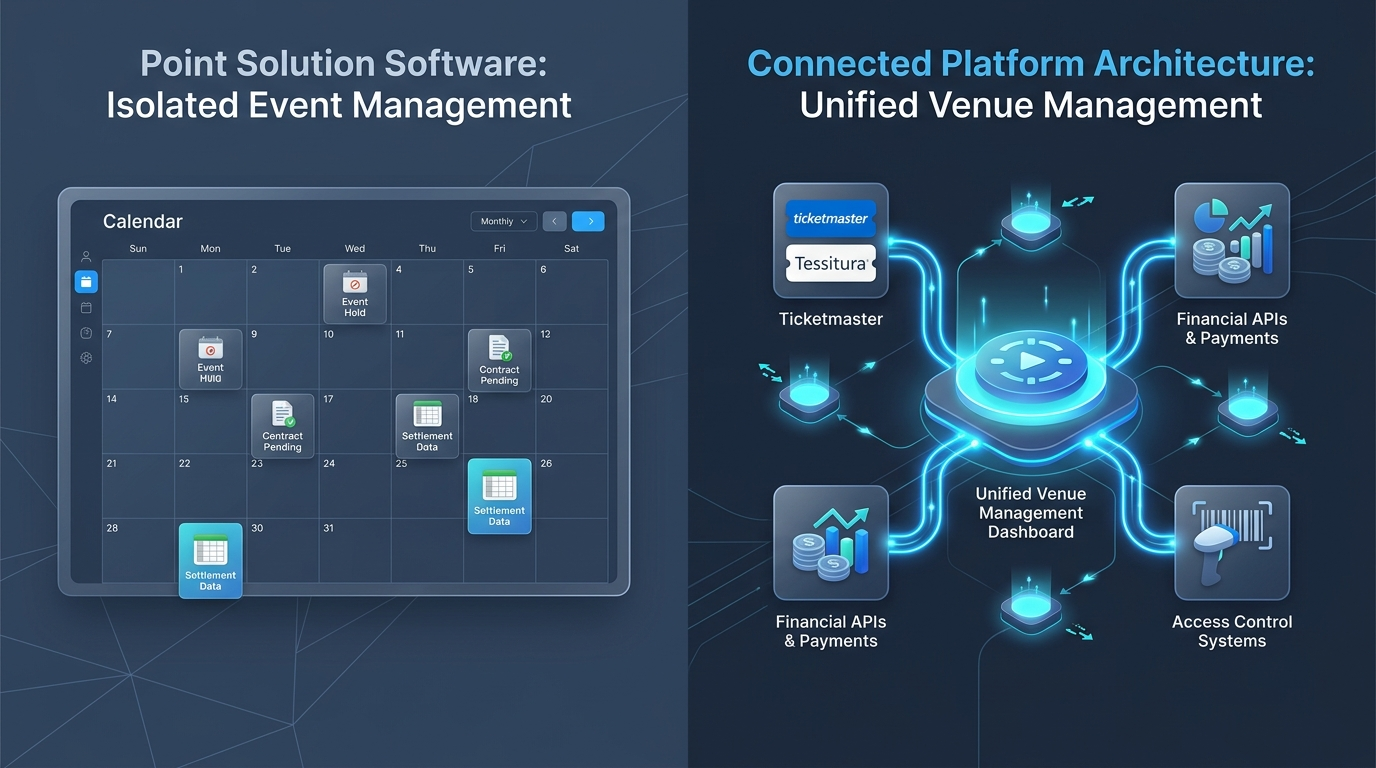
An event management platform is a broader software foundation designed to connect core event-management functionality with other applications, data sources, integrations, or extensible workflows.
That architecture matters when an organization needs its event-management system to participate in a larger technology environment.
For example, a theatre may want booking information connected to a ticketing system. A church may want data to work alongside other internal systems. A park district may eventually need event information to flow into other reporting or operational workflows.
The important question is not whether the vendor uses the word “platform.”
Ask:
What can this system connect to, extend, export, or automate outside its built-in features?
That question will tell you much more than the product category on the homepage.
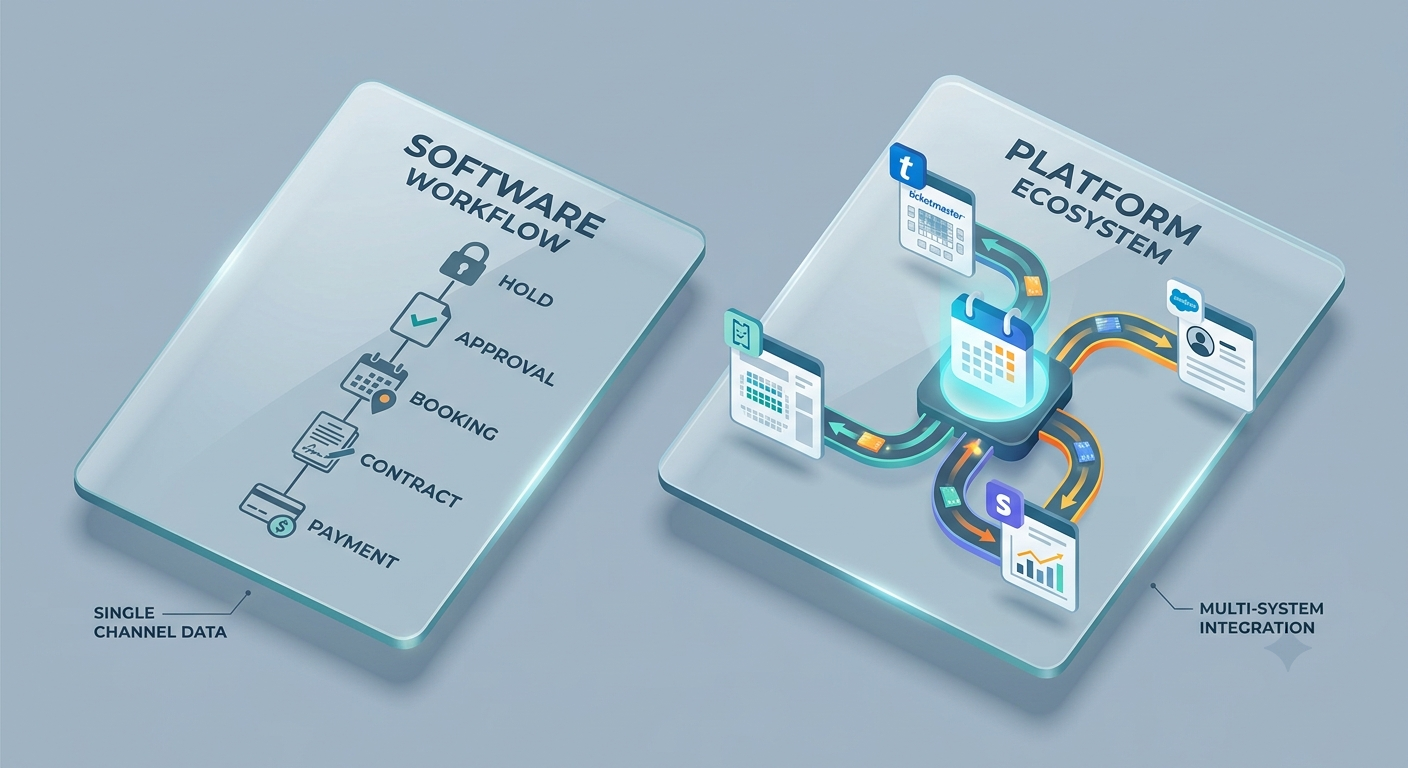
Platform vs. software: what is the actual difference?
| Question | Event management software | Event management platform |
|---|---|---|
| Core event workflows | Yes | Yes |
| Scheduling and booking | Yes | Yes |
| Event records | Yes | Yes |
| Built-in reporting | Usually | Usually |
| Built-in integrations | Depends on product | Usually a major consideration |
| API access | May be limited or absent | More likely to be part of the architecture |
| Extensibility | Often centered on vendor features | More emphasis on connected systems and extension |
| Best fit | Organizations needing a defined application | Organizations treating event technology as part of a larger stack |
This is a useful distinction, but do not turn it into a buying rule.
A small community theatre may get more value from well-designed event-management software than from a highly extensible platform it never integrates with.
A platform is only more valuable when the organization actually needs the additional architectural capability.
Why do vendors call everything a “platform”?
Because “platform” sounds larger than “software.”
There is no universal technical standard that forces an event technology vendor to earn the term. A product can have a large feature set, call itself a platform, and still offer very little extensibility.
That means the buyer has to look underneath the label.
When a vendor says “platform,” ask:
- Is there an API?
- What data can the API expose?
- Can third-party applications write data back?
- Which integrations are native?
- Are integrations one-way or two-way?
- Can identity and permissions connect to existing systems?
- Can the organization export its data?
- Does the vendor publish developer documentation?
- Are integrations included, optional, or dependent on custom work?
These questions turn a vague marketing claim into something measurable.
Does your venue actually need a platform?
Most venues do not need a platform simply because a vendor calls its product one. They need software that solves their operational problems and integrates with the systems they genuinely depend on.
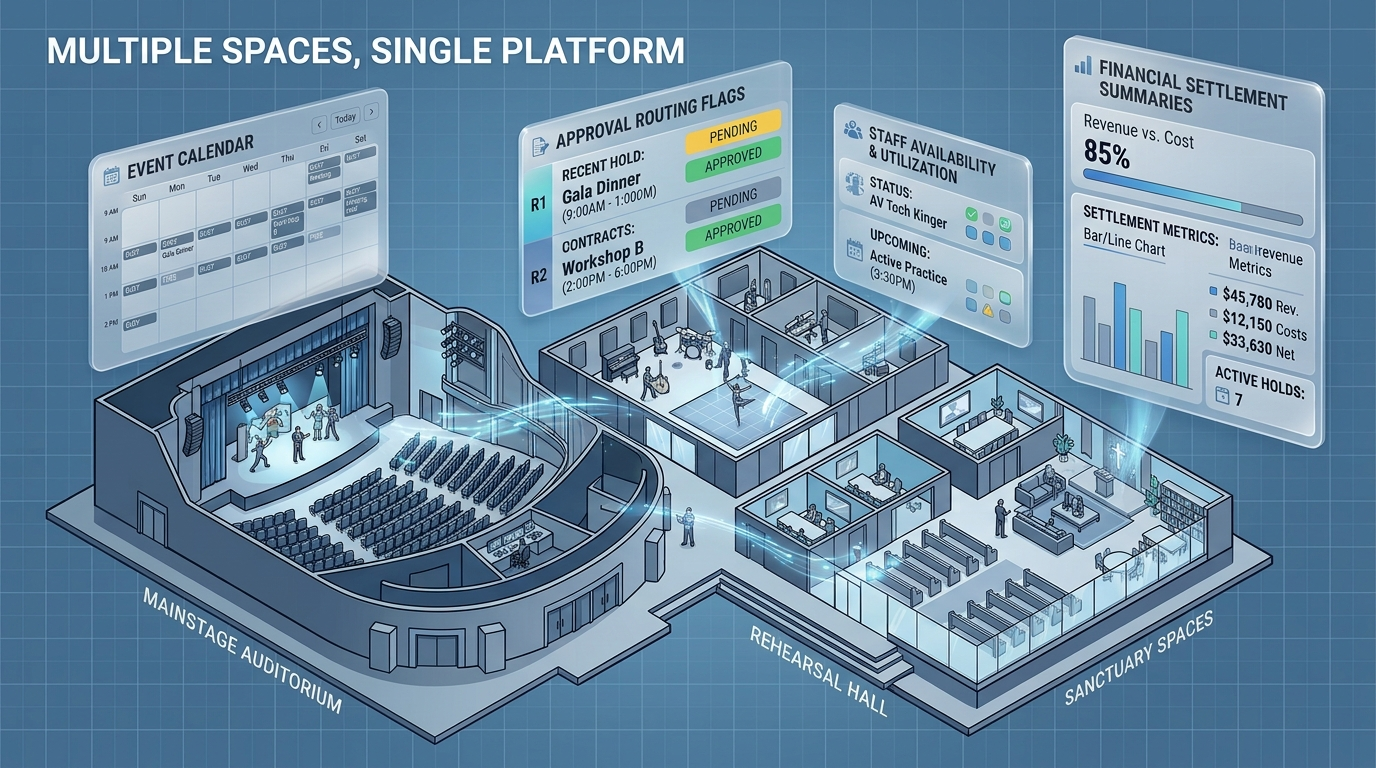
Consider a community theatre with a mainstage, rehearsal hall, and studio.
The theatre needs to manage:
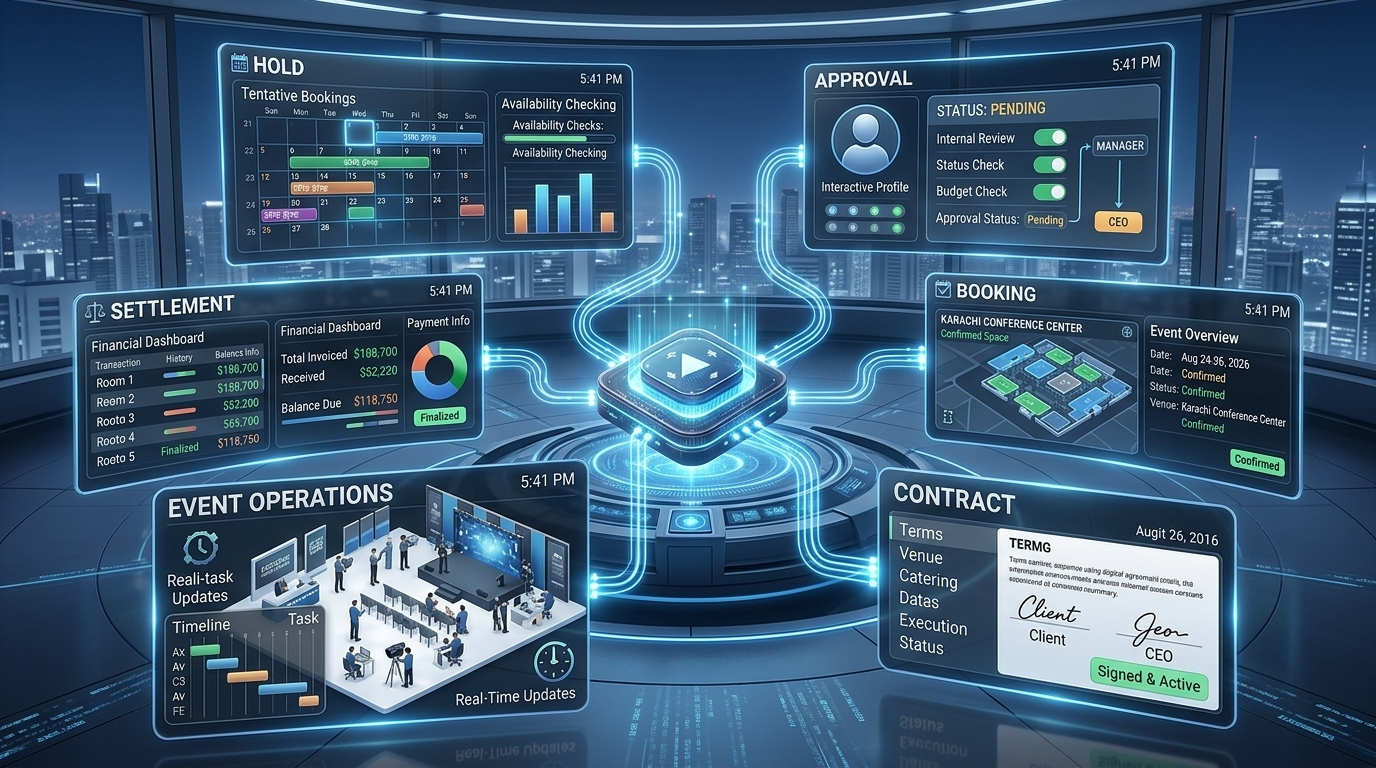
That workflow is valuable even if the theatre never builds a custom integration.
Now add a ticketing system.
If the venue needs the booking environment to connect with a ticketing platform, integration becomes a meaningful architectural requirement. That is where the “platform” question becomes useful.
The theatre does not need a platform because platforms are fashionable. It needs an event-management system that can participate in the technology stack it already has.
When is event management software enough?
Event management software is enough when your operational needs are well served by the product’s built-in functionality and the integrations it already supports.
A community venue may not need an extensible architecture if:
- it has a straightforward technology stack
- its existing systems already meet its needs
- staff do not need custom integrations
- standard reports are sufficient
- the venue primarily needs better booking and operational control
- there is no internal development team maintaining connected systems
In these cases, buying “a platform” can create complexity without delivering additional value.
The goal is not to buy the most technically impressive architecture.
The goal is to remove the operational gaps between booking, contracts, payments, event execution, and reporting.
When does extensibility actually matter?
Extensibility matters when your venue’s event system needs to become part of a wider digital workflow.
For example, a multi-campus house of worship might eventually want event data connected to other organizational systems.
A performing arts organization might need booking information to work alongside a ticketing platform.
A park district might need structured data for reporting or downstream workflows.
In those situations, APIs and integrations are not abstract technical features. They determine whether your event system can exchange information with the systems already around it.
What should a venue evaluate instead of the label?
The strongest buying framework is to evaluate the architecture and the workflow separately.
| What to evaluate | Question to ask |
|---|---|
| Booking workflow | Can the system represent holds, requests, approvals, and confirmed bookings? |
| Operational workflow | Can event details move from booking into execution without re-entry? |
| Contracts | Can the agreement stay connected to the event? |
| Financial workflow | Can deposits, balances, and settlement information stay tied to the booking? |
| Permissions | Can volunteers, staff, finance, and leadership have appropriate access? |
| Integrations | Can the system connect to the applications you actually use? |
| APIs | Can your organization access or exchange data when required? |
| Reporting | Can leadership see utilization, revenue, and demand without rebuilding reports manually? |
| Data portability | Can you get your information out if your requirements change? |
This approach prevents a common mistake: choosing the product with the longest feature list rather than the product that fits the organization’s workflow.
A practical example: platform or software for a church?
Imagine a church with a sanctuary, fellowship hall, classrooms, and gym.
The church needs:
- recurring bookings
- exceptions to recurring schedules
- approval workflows
- user permissions
- outside-renter records
- contracts
- insurance documents
- payment tracking
- reporting
If the church also has other technology systems that need to exchange event information, integration capability becomes important.
But if the church’s immediate problem is that bookings live in spreadsheets, approvals happen by email, and volunteers cannot see the right information without sharing accounts, the immediate value comes from getting the core workflow under control.
The technology label is secondary.
The decision is simpler than the terminology makes it sound
“Platform” and “software” are not competing categories in the way marketers often present them.
Software is the application you use.
A platform is generally software designed to provide a broader foundation for integrations, APIs, and extension.
But your venue should not buy a platform because the label sounds more sophisticated.
Buy the system that can manage the actual work.
For a community theatre, that means holds, bookings, contracts, event operations, and settlement. For a house of worship, it may mean recurring services, ministry bookings, outside rentals, permissions, and multi-campus visibility. For a park district, it may mean facility requests, approvals, permits, pricing, and public access.
Then ask the architecture question:
Can the system connect to the rest of the technology you actually use?
That is the difference worth paying attention to.
Frequently Asked Questions
- Is an event management platform different from event management software?
Yes, but the difference is usually architectural rather than operational. Software is the application you use, while a platform is usually a broader foundation designed to connect with other systems through integrations, data exchange, or extensible workflows.
- Does a venue need a platform or just software?
Most venues need software that fits their workflow first. A platform becomes important only when the venue has real integration requirements, API needs, or a broader technology ecosystem to connect with.
- What should a venue evaluate before buying?
Evaluate the event lifecycle, not the marketing label. Ask whether the system manages booking requests, approvals, contracts, payments, operations, reporting, permissions, and integrations in a way that matches your venue's actual process.
- When is event management software enough?
It is enough when the product handles the venue's core workflow well and the organization does not need broader extensibility or custom connections with other systems.
- Why do vendors call everything a platform?
Because 'platform' sounds broader and more enterprise-ready. In practice, the term is often used as marketing language, so buyers should verify the actual integrations, APIs, and architecture instead of relying on the label.
Ready to simplify your venue operations?
See how VenueArc helps venue teams coordinate bookings, approvals, documents, and settlement without routine operational chaos.