venue management
Facility Rental Revenue: How Community Venues Turn Unused Space Into Income
Learn how churches, theatres, and park districts price, contract, and manage facility rentals while tracking revenue, profitability, and utilization.
IN THIS ARTICLE
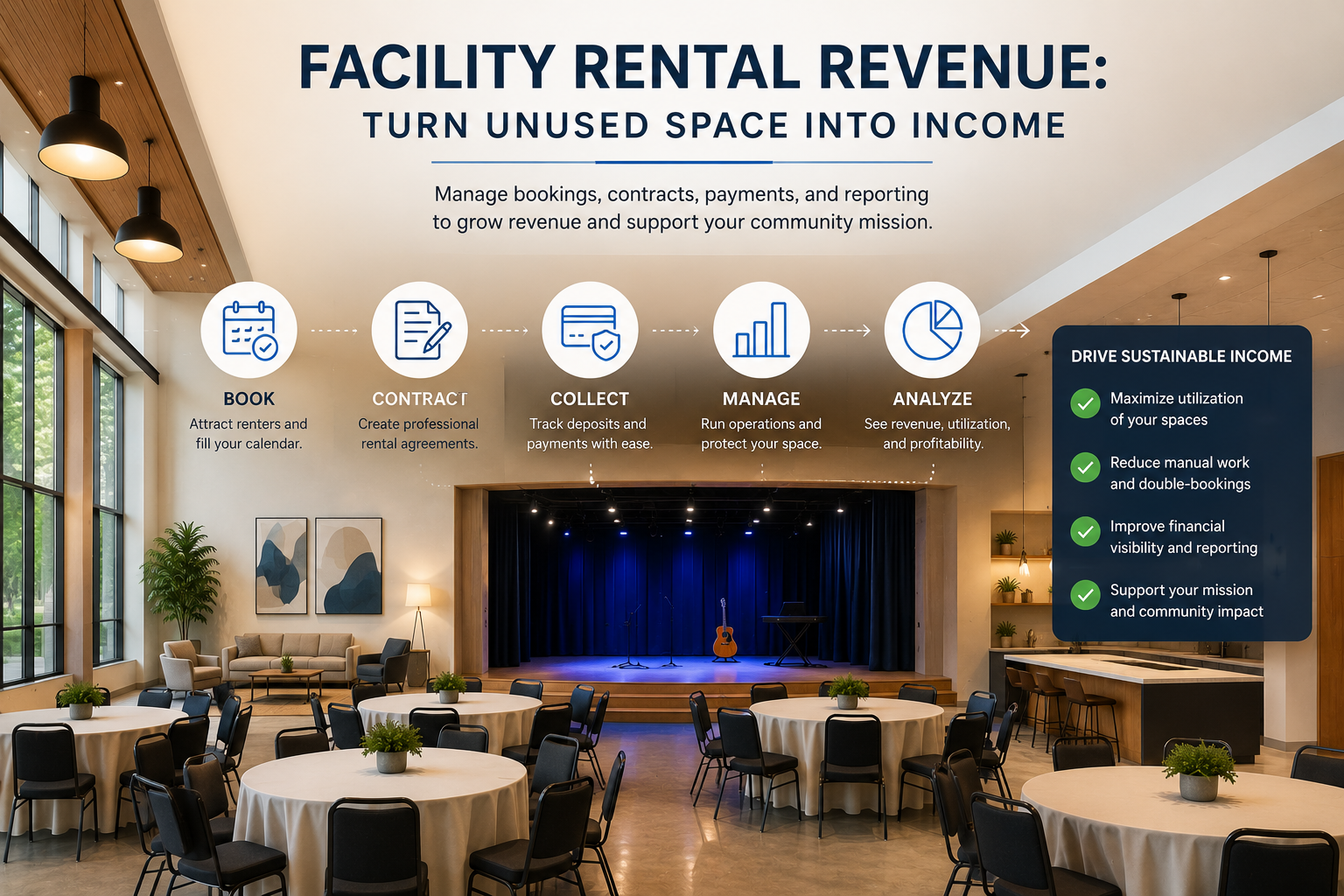
Most community venues already own valuable assets that sit unused for large portions of the week. Facility rental revenue is the process of turning those underused spaces into a structured, manageable source of income without losing control of scheduling, operations, or mission priorities. Venue rental software helps organizations manage bookings, contracts, payments, and reporting from a single system rather than relying on spreadsheets and email chains.
For churches, community theatres, and park districts, rental income is rarely about maximizing profit at all costs. It is usually about sustainability. A fellowship hall helps offset maintenance costs. A theatre earns additional revenue by renting dark dates. A community center generates funds that support programming and facility improvements. The challenge is not finding demand. The challenge is managing rentals consistently while protecting the spaces that serve the community every day.
Definition: Facility rental revenue is income generated by making venue spaces available to outside groups, organizations, or individuals through a structured booking, contracting, payment, and reporting process.
Key takeaways
- Community venues often have rentable space inventory that remains unused for significant periods each week, creating revenue opportunities.
- A fully booked calendar does not automatically mean a facility is operating profitably.
- Successful rental programs require more than booking management. Contracts, deposits, insurance documentation, payment schedules, and reporting are equally important.
- Churches, community theatres, and park districts have different operational requirements that influence rental policies.
- Software becomes most valuable when it connects booking records, contracts, payments, and reporting into a single system of record.
Why facility rentals matter more than ever
Facility rental programs are often viewed as a side activity. In reality, they are increasingly becoming part of the operating model for community-focused organizations.
Many facilities already have fixed expenses that exist whether a room is used or not:
- Utilities
- Maintenance
- Cleaning
- Staffing
- Insurance
- Repairs
- Capital improvements
Those costs continue regardless of whether a room sits empty on Tuesday night or hosts a paying event. By creating a structured rental program, organizations can generate revenue from assets they already own without making major capital investments.
The opportunity becomes especially significant for facilities with multiple spaces:
| Facility Type | Common Rentable Spaces |
|---|---|
| Church | Fellowship halls, classrooms, meeting rooms, gymnasiums |
| Community Theatre | Main stage, rehearsal spaces, studios, lobby areas |
| Park District | Community centers, shelters, athletic fields, courts |
| Municipal Venue | Council halls, event rooms, conference areas |
Many organizations discover that their most valuable asset is not necessarily their largest room. Sometimes the highest-demand spaces are smaller meeting rooms that can be rented frequently throughout the year.
The mission-versus-revenue question
For many organizations, especially houses of worship, facility rentals can create an uncomfortable conversation.
Leaders often ask:
“Are we becoming a business?”
The better question is usually:
“Can responsible rental income help us support our mission?”
A church can use rental revenue to help fund community outreach programs, facilities maintenance, youth programming, or operational costs. A community theatre may rent the facility between productions to support arts programming. A park district may use rental revenue to offset operational expenses.
The most successful organizations do not treat rentals as their mission. They treat rentals as a mechanism that helps sustain the mission.
For example:
- A church may prioritize ministry activities over external rentals.
- A theatre may reserve prime performance dates for its own productions.
- A park district may maintain resident-priority booking policies.
Rental revenue works best when it supports the organization’s purpose rather than competing with it.
What actually makes a rental program successful?
Many facility rental programs fail for reasons that have nothing to do with market demand.
The problem is usually operational.
A typical manual process looks like this:
- Inquiry arrives by email.
- Staff checks a calendar.
- Approval requires additional emails.
- Rental agreement is created manually.
- Deposit tracking happens in a spreadsheet.
- Insurance certificates are stored elsewhere.
- Staff members cannot easily tell what has been paid.
- Reporting happens using multiple systems.
A successful rental operation brings these activities together:
| Process | Why it matters |
|---|---|
| Booking management | Prevents conflicts and double-bookings |
| Contract management | Defines responsibilities clearly |
| Payment tracking | Ensures deposits and balances are collected |
| Document storage | Keeps agreements and insurance certificates accessible |
| Reporting | Understands profitability and utilization |
| Permissions | Controls who can approve and modify bookings |
The goal is not simply to book more events. The goal is to manage rentals consistently enough that growth does not create operational chaos.
Need help evaluating your workflow?
If your team is comparing booking tools, the most useful next step is a workflow-specific demo based on your actual requests, holds, and approval rules.
Book a DemoHow to price facility rentals without guesswork
Facility rental pricing works best when it follows a clear framework rather than a series of one-off decisions.
Most community venues typically use one of three approaches:
| Pricing Model | Description | Common Users |
|---|---|---|
| Cost Recovery | Covers staffing, utilities, cleaning, and maintenance costs | Churches, nonprofits |
| Market Rate | Based on local rental market conditions | Independent venues |
| Tiered Pricing | Different rates for different renter categories | Park districts, municipalities |
Cost-recovery models focus on sustainability rather than profit generation. Market-rate pricing follows local demand and competitive pricing. Tiered pricing is common when organizations serve multiple constituencies with different priorities.
What should be included in a rental rate?
A rental fee should reflect more than access to a room.
Potential cost factors include:
- Facility setup
- Cleaning services
- Security personnel
- Equipment usage
- Utilities
- Staff supervision
- Administrative time
Many organizations eventually separate pricing into categories:
| Charge Type | Purpose |
|---|---|
| Rental Fee | Access to the facility |
| Setup Fee | Room preparation |
| Staffing Fee | On-site support |
| Cleaning Fee | Post-event cleanup |
| Security Fee | Security coverage |
| Equipment Fee | Optional resources |
Separating these costs helps renters understand how pricing works and reduces billing disputes.
The rental agreement protects everyone
A booking should never rely solely on verbal agreements or email conversations.
A typical facility rental agreement may address:
- Rental dates and times
- Approved spaces
- Capacity limits
- Deposit requirements
- Cancellation policies
- Cleaning responsibilities
- Equipment usage
- Insurance requirements
- Alcohol policies
- Damage responsibilities
Houses of worship
Rental agreements may include ministry-use restrictions and sanctuary-use limitations.
Community theatres
Rental agreements often cover load-in periods, technical staffing, and strike requirements.
Park districts
Rental agreements frequently include permit requirements and public-use policies.
The objective is not legal complexity. The objective is clarity.
Insurance requirements and certificates of insurance
Many rental programs require external renters to provide a Certificate of Insurance (COI) before the event date.
Insurance requirements become especially important when events involve:
- Large attendance
- Outside vendors
- Food service
- Alcohol
- Athletic activities
- High-value equipment
Document management becomes critical because certificates typically expire and must remain associated with the correct booking records.
Deposits and payment schedules
Successful rental programs collect payments based on defined schedules.
A typical payment structure might include:
| Stage | Example Purpose |
|---|---|
| Reservation Deposit | Secures booking date |
| Interim Payment | For larger rentals |
| Final Payment | Prior to event |
| Damage Deposit | Protects facility |
The exact schedule varies based on policy. The important principle is consistency.
Why fully booked does not mean profitable
A full calendar feels productive. However, a full calendar does not automatically produce strong financial results.
| Space | Annual Bookings | Revenue Per Booking |
|---|---|---|
| Small Meeting Room | 150 | $75 |
| Event Hall | 25 | $1,000 |
The meeting room appears busier. The event hall may produce more revenue. Revenue reporting must be evaluated alongside:
- Occupancy
- Operating costs
- Staffing requirements
- Maintenance expenses
Understanding space utilization vs revenue
Facility utilization and revenue are related but different measurements.
Space utilization measures how often a room is used. Revenue measures financial outcomes. Venue leaders should ultimately ask:
Which spaces create the greatest operational and financial value?
Answering that question requires analyzing:
- Rental frequency
- Rental type
- Revenue generated
- Cost to support each booking
- Demand trends
- Seasonal patterns
Settlement and reconciliation
Settlement is the process of reconciling what was booked, what was delivered, what was charged, and what was actually paid.
A complete settlement process may include:
- Rental charges
- Staffing fees
- Equipment charges
- Cleaning fees
- Security fees
- Damage assessments
- Deposit refunds
- Outstanding balances
Settlement ensures that every event reaches a financially complete conclusion.
Reporting that actually improves revenue
Revenue reporting is valuable only if it helps decision-makers improve future performance.
Important questions include:
- Which space generates the most revenue?
- Which space has the highest demand?
- Which renter categories are most profitable?
- Which rentals require the most staff time?
| Question | Why It Matters |
|---|---|
| Which facility generates the most revenue? | Supports investment decisions |
| Which facility has unused capacity? | Creates growth opportunities |
| Which renter types create the least operational burden? | Improves policies |
| What are seasonal demand patterns? | Supports forecasting |
Reports should guide future actions, not simply document past activity.
Measuring profitability by space instead of by building
Most organizations evaluate facility performance as a whole. A more useful approach measures performance by individual space.
| Space | Revenue | Estimated Operating Cost | Net Contribution |
|---|---|---|---|
| Fellowship Hall | Higher | Moderate | Strong |
| Classroom A | Moderate | Low | Strong |
| Gymnasium | High | High | Moderate |
| Meeting Room | Low | Low | Moderate |
Tracking profitability at the building level alone can conceal valuable insights.
The role of venue rental software
Venue rental software is most valuable when it connects every stage of the rental lifecycle into one operational record.
An effective platform typically brings together:

When facility rentals are not the right strategy
Facility rental revenue is not always the correct answer.
A rental program may not be appropriate when:
- Staffing resources are extremely limited
- Insurance requirements cannot be managed
- Internal programming already uses the space heavily
- Governance policies are unclear
Similarly, not every venue requires dedicated rental software. A facility with a single rentable room and minimal annual bookings may be able to manage operations manually.
The next decision: build visibility before expanding rentals
Most organizations do not struggle because they lack rentable space.
They struggle because they lack visibility into:
- What is being rented
- Who is renting it
- What revenue is generated
- What costs are incurred
- Which spaces perform best
For churches, community theatres, and park districts, success is not simply about generating more bookings. Success comes from creating a repeatable operational process that connects booking management, contracts, payment tracking, settlement, document management, and reporting into a single system of record.
Frequently Asked Questions
- What is facility rental revenue?
Facility rental revenue is income generated by leasing underused venue space to outside groups, organizations, or individuals through a structured booking, contract, payment, and reporting process.
- How do community venues price rentals without guesswork?
Most venues use cost-recovery, market-rate, or tiered-pricing models. The best approach matches the venue's mission, demand, and operating costs rather than relying on one-off rates.
- Why does a fully booked calendar not guarantee profitability?
Busy spaces can still lose money if staffing, cleaning, utilities, insurance, and maintenance costs exceed the revenue generated by the bookings.
- What should be included in a rental agreement?
A sound rental agreement should define time, space, capacity, fees, deposits, cancellations, insurance, cleaning, and damage responsibilities so both parties understand the obligations.
- What reports matter most for venue leadership?
The most useful reports track revenue by space, utilization by facility, outstanding balances, seasonal demand, and net contribution after operating costs.
Ready to simplify your venue operations?
See how VenueArc helps venue teams coordinate bookings, approvals, documents, and settlement without routine operational chaos.