▼ In This Article
Facility Rental Management for Places of Worship: How to Manage Room Bookings, External Rentals, and Shared Spaces
A wedding party is setting up in the fellowship hall. A community group is renting the social hall down the hallway for a fundraiser. And somewhere in a filing cabinet or maybe an inbox, or maybe nowhere at all, is the certificate of insurance one of them was supposed to provide two weeks ago. If this scenario feels a little too familiar, you are not alone. Most churches, mosques, temples, and synagogues eventually run into the same challenge: their building is a genuine community asset, but the process for managing who uses it, when, and under what terms has not kept pace with how often it is actually being used.
That is what facility rental management is really about: the workflow that lets a place of worship balance its own ministry or congregational use with outside rentals, without losing track of approvals, agreements, insurance, payments, or the building itself. This guide walks through how that workflow should actually work: from the first request to the final walkthrough after the event, plus the legal, insurance, and tax considerations that come with letting outside groups use a religious facility.
Whether you are running a single church building or coordinating shared spaces across a mosque, temple, or synagogue campus, the underlying operating model is the same, and getting it right protects both your community’s mission and its bottom line.
A note before we start: this article covers common practices and general considerations, not legal or tax advice. Facility use agreements, insurance requirements, and tax treatment of rental income can vary by state, denomination, and situation. Always consult an attorney and a CPA familiar with nonprofit and religious organizations before finalizing your policies.
What Is Facility Rental Management for a Place of Worship?
Facility rental management is the process of coordinating internal ministry or congregational use of a building alongside external rentals to outside groups, covering requests, approvals, agreements, insurance, payments, setup logistics, and reporting, all within the shared rhythm of a religious calendar.
It sits one layer beyond basic room scheduling. Scheduling answers “is the room available?” Facility rental management answers a broader set of questions: who is allowed to book this space? What do they need to provide before we approve it? What happens if something goes wrong? And how do we track the income and activity for our board or leadership?
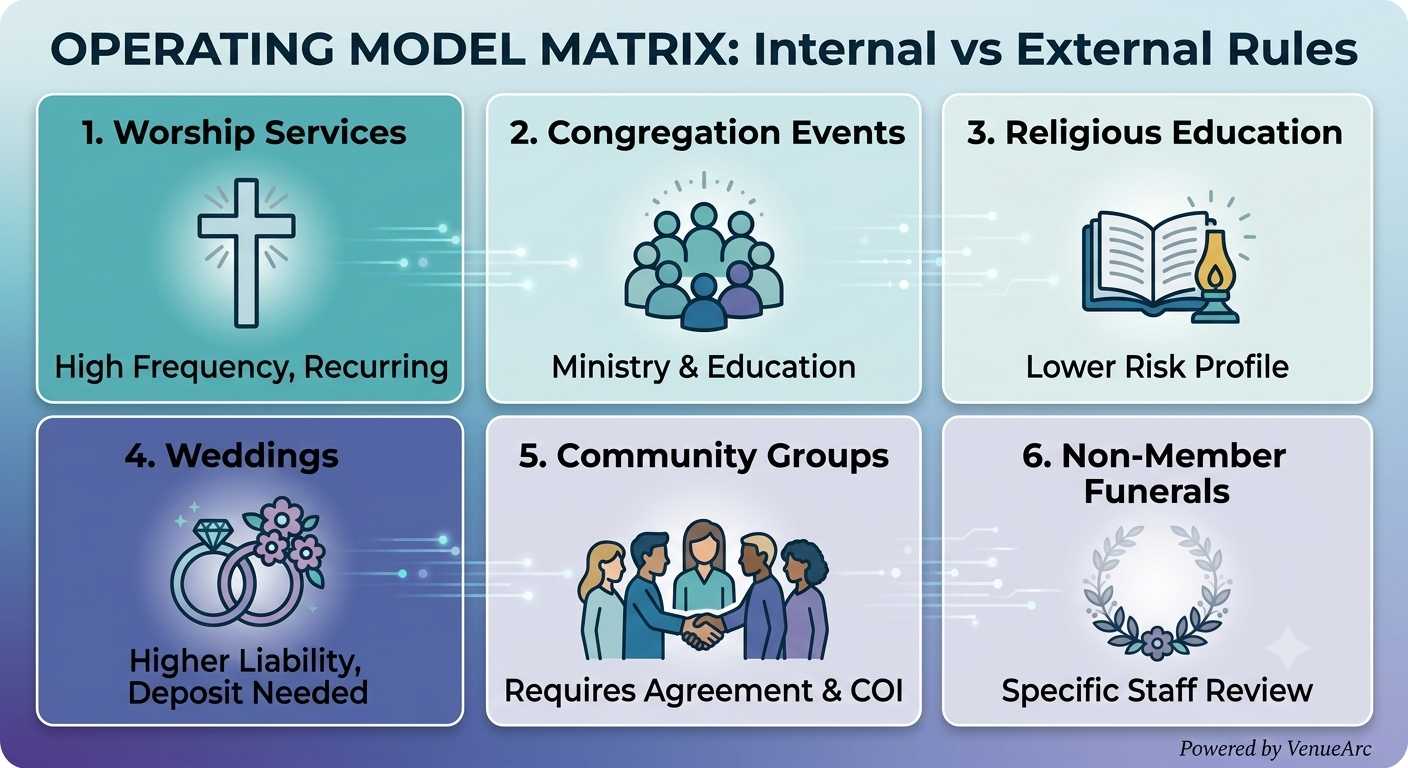
Internal Ministry Use vs. External Rental Use
These two categories usually need different rules, and conflating them is one of the most common sources of confusion:
- Internal use: worship services, religious education, ministry meetings, congregation-run events. Often free, frequently recurring, and generally lower-risk from a liability standpoint.
- External rental: weddings, funerals for non-members, community organization meetings, fundraisers, and other outside groups paying to use the space. Usually requires an agreement, insurance documentation, a deposit, and closer approval review.
Setting this distinction explicitly in writing is the foundation everything else in this guide builds on.
Why Room Bookings Get Complicated at Houses of Worship
A few things make scheduling at a place of worship more complex than a typical shared-space rental:
- Recurring religious rhythms: weekly services, holy days, religious education, and seasonal or liturgical cycles need to take priority over discretionary rentals.
- Multi-use buildings: the same social hall, fellowship hall, or dining room might host a religious education class, a wedding reception, and a community meeting in the same week.
- Limited administrative capacity: many houses of worship run on a small staff or volunteer office team, which makes manual tracking of agreements, insurance, and deposits especially error-prone.
- Values-sensitive decisions: not every rental request is a simple yes or no. Some communities have policies about what kinds of events or groups are appropriate for a sacred space, which adds a layer of judgment beyond a typical facility rental.
The Core Facility Rental Workflow
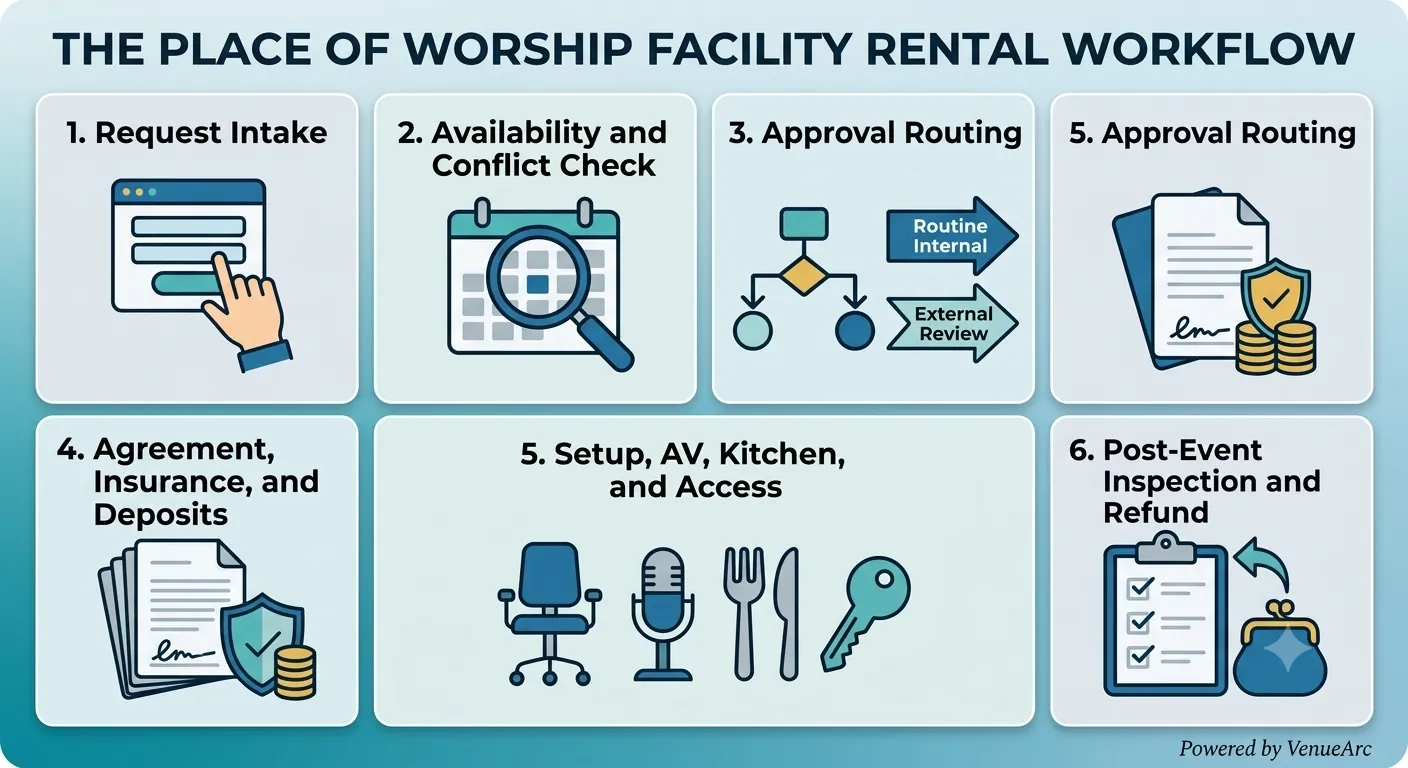
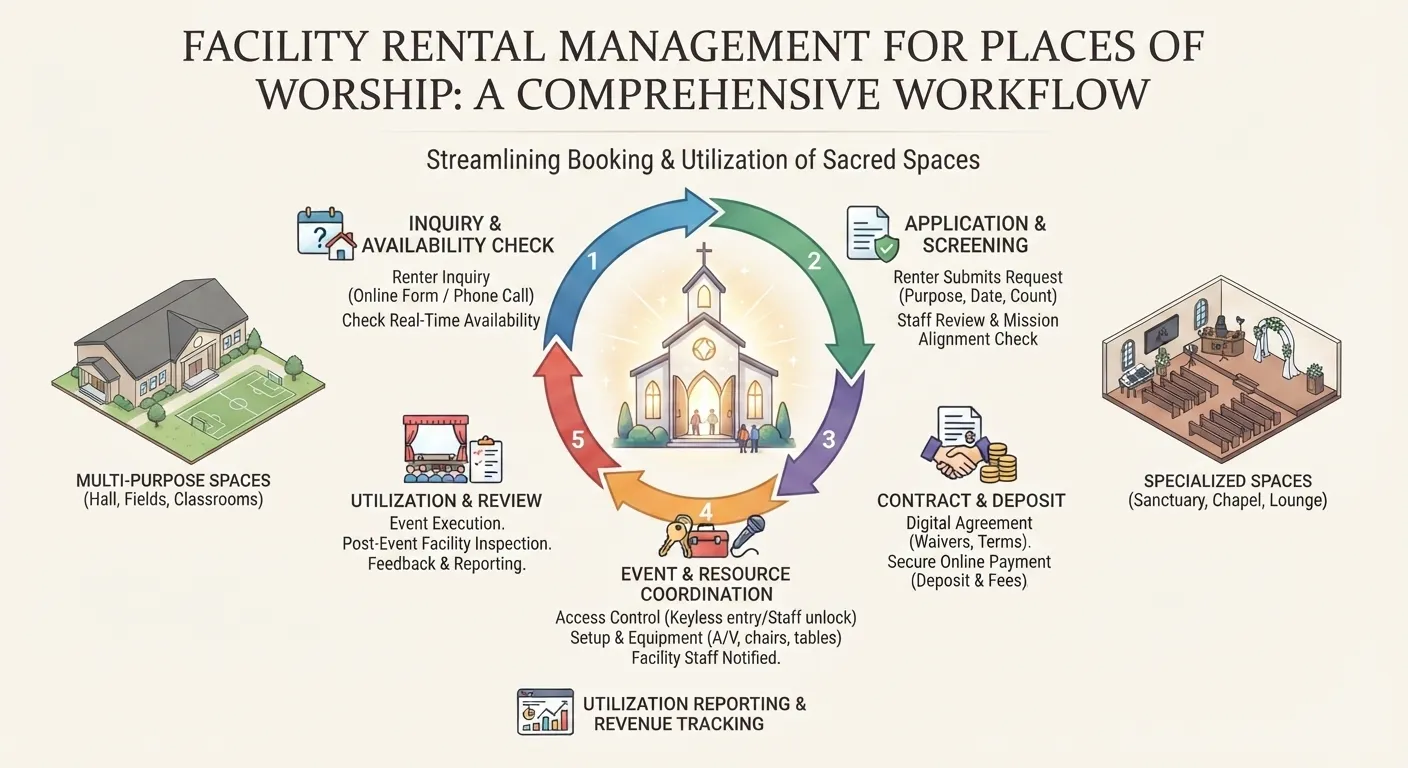
A reliable rental process generally moves through six stages:
1. Request Intake
Every request, internal or external, starts here. The clearer the intake form, the fewer surprises later.
2. Availability and Conflict Check
Check the requested space and any resources (AV, kitchen, tables and chairs) against the existing calendar, including recurring internal events and blackout dates around holy days or major services.
3. Approval Routing
Route the request to the right approver. Routine internal bookings might not need review at all; external rentals typically should go through a designated staff member or committee.
4. Agreement, Insurance, and Deposits
For external rentals, this is the stage where a facility use agreement, certificate of insurance, and damage deposit typically get collected, before the booking is finalized, not after.
5. Setup, AV, Kitchen, and Access
Confirm what the renter needs: tables, chairs, AV equipment, kitchen access, parking, and who is responsible for unlocking and locking the building.
6. Post-Event Inspection and Refund
A quick walkthrough after the event confirms the space was left in good condition, which determines whether and how much of a damage deposit gets returned.
What to Include in a Facility Rental Request Form
A well-built request form does most of the work of preventing problems downstream. At minimum, include:
| Field | Why it matters |
|---|---|
| Event type and description | Helps assess appropriateness and staffing needs |
| Requested date, time, and room(s) | Core scheduling information |
| Expected attendance | Affects room choice and setup |
| Food/catering plans | Kitchen access, cleanup responsibility |
| AV and equipment needs | Determines setup requirements |
| Insurance documentation status | Flags whether a COI is needed and on file |
| Setup/teardown time needed | Prevents back-to-back booking conflicts |
| Recurring or one-time | Determines if this affects a standing schedule |
| Contact and organization info | Needed for the agreement and communication |
Internal Events vs. External Rentals: Setting Clear Rules
A simple priority and pricing matrix helps staff make consistent decisions without re-litigating every request:
| Category | Priority | Pricing | Approval needed | Documentation required |
|---|---|---|---|---|
| Recurring worship/religious education | Highest | Free | Rarely | None |
| Member-hosted life events (weddings, funerals, receptions) | High | Reduced or free | Staff review | Facility use agreement |
| Community/nonprofit groups | Medium | Standard rate | Staff or committee review | Agreement + COI |
| Commercial or for-profit rentals | Lowest priority for approval | Full rate | Committee/leadership review | Agreement + COI + deposit |
Adjust the categories to fit your own community’s policies. The structure matters more than the exact labels.
Facility Use Agreement Basics
A facility use agreement (sometimes called a license agreement) is the document that governs an outside group’s use of your space, typically covering dates and times, permitted use, fees and deposits, cancellation terms, insurance requirements, and liability provisions.
It is worth understanding the difference between this and a lease: a facility use agreement generally grants temporary, revocable permission to use a space for a specific event, while a lease grants longer-term, exclusive rights to a property. Using the wrong type of document can create legal and tax complications, so this is an area where legal counsel is worth the investment, even a basic review of your standard template.
Common elements to include (again, have counsel review your actual template):
- Dates, times, and specific spaces covered
- Permitted use and any prohibited activities
- Fees, deposits, and refund or cancellation terms
- Insurance and indemnification requirements
- Damage responsibility
- Supervision requirements for events involving children or youth
Insurance and Risk-Management Checklist
Before approving an external rental, most houses of worship collect:
- A signed facility use agreement
- A certificate of insurance (COI) from the renter
- Additional insured status naming the religious organization on the renter’s policy
- A hold-harmless or indemnification clause
- Confirmation of supervision plans for any event involving children or youth
- A damage deposit, where applicable
Set a clear deadline for these documents. Many organizations require the COI on file at least one to two weeks before the event, not the day of.
Tax and Financial Considerations
Rental income raises a natural question for nonprofit and religious organizations: does renting out space create tax exposure? The short answer in plain English: rental income from real property is generally excluded from unrelated business income tax (UBTI), but there are exceptions, including when substantial services are provided to the renter, when the rental is tied to debt-financed property, or in certain mixed lease-and-services arrangements.
This is genuinely fact-specific, and the right answer depends on your organization’s particular situation. Talk to a CPA or tax advisor familiar with nonprofit and religious organizations before assuming your rental income is automatically excluded, especially if you are renting frequently, providing catering or staffing as part of the rental, or generating significant revenue from outside use.
How Software Simplifies Facility Rental Management
Every step of the workflow above can be run manually. Many houses of worship do exactly that for years. But as rental volume grows, a few structural gaps tend to show up:
- Manual tracking makes it easy to miss a document deadline: an insurance certificate that was supposed to arrive two weeks before the event gets forgotten until the morning of.
- Spreadsheets do not enforce your priority rules: nothing stops a commercial rental from getting approved ahead of a recurring internal event if the person handling requests is not paying close attention.
- Payments and deposits get disconnected from the booking itself, making reconciliation at the end of the month or quarter a manual exercise.
- Reporting to leadership becomes a special project instead of something you can pull up on demand.
Dedicated facility rental management software addresses these by keeping the calendar, approvals, agreements, insurance tracking, payments, and reporting connected in one system rather than split across a calendar, an inbox, a filing cabinet, and a spreadsheet.
Common Challenges and How to Avoid Them
Challenge: Internal and external bookings compete for the same space without clear priority rules. Avoid it by documenting a priority matrix (like the one above) so staff are not making judgment calls case by case.
Challenge: Insurance documentation arrives late or not at all. Avoid it by setting a firm deadline (for example, 10 to 14 days before the event) and making the booking contingent on the document being on file.
Challenge: Renters do not fully understand what is expected of them. Avoid it by using a clear, written facility use agreement rather than a verbal understanding or informal email exchange.
Challenge: Damage or cleanup disputes happen after the event, with no record of the space’s condition beforehand. Avoid it by doing a quick pre- and post-event walkthrough, even if it is just a few photos.
Challenge: Rental income tracking is disconnected from the church’s general financial reporting. Avoid it by using a system where bookings, payments, and deposits are tied together, so financial reporting does not require manual reconciliation.
Challenge: Volunteers or part-time staff do not have a consistent process to follow. Avoid it by documenting the workflow itself, not just the software, so anyone handling requests can follow the same steps.
Best Practices
- Put your priority rules in writing before you need to make a judgment call under pressure.
- Require documentation before confirming, not after. A tentative hold pending insurance and agreement is safer than a locked-in booking.
- Set blackout dates for holy days and major services well in advance so they cannot be accidentally booked by mistake.
- Standardize your facility use agreement and have it reviewed periodically by counsel, rather than customizing it ad hoc for each renter.
- Track rental activity and revenue in a way that is easy to report to your board, elder team, or clergy leadership without a manual pull.
- Do a walkthrough before and after every external rental, even briefly, to protect both the space and the relationship with the renter.
Practical Examples Across Faith Communities
Churches: A church fellowship hall might host a wedding reception on Saturday and a community support group meeting on Tuesday, each needing different setup, and each falling into a different tier of the priority matrix above.
Mosques: A mosque’s community room might be used for religious education during the week and rented to a local community organization on weekends, with prayer times and Friday services taking scheduling priority regardless of external requests.
Synagogues: A synagogue’s social hall or classrooms often serve b’nai mitzvah celebrations, religious school, and community events, with major holidays requiring blackout dates well in advance of the general calendar.
Temples: A temple’s dining or community hall might host both congregational meals and outside cultural events, with recurring festival and observance dates needing the same advance-blocking treatment as any other holy day.
Across all four, the operating model is the same: internal religious use takes priority, external use follows clear rules, and documentation happens before the event, not after.
How to Evaluate Facility Rental Management Software
| Capability | Why it matters |
|---|---|
| Shared calendar for internal and external bookings | One source of truth instead of separate systems |
| Configurable approval workflows | Different rules for different request types |
| Agreement and insurance document tracking | Prevents missed deadlines |
| Deposit and payment tracking tied to bookings | Simplifies financial reconciliation |
| Setup/resource scheduling (AV, kitchen, tables) | Coordinates the full event, not just the room |
| Role-based permissions | Staff, clergy, volunteers, and renters see only what they need |
| Reporting on utilization and rental revenue | Supports board and leadership decisions |
| Multi-site or multi-building support | Needed for larger or multi-campus organizations |
Future Trends in Facility Rental Management
- Rental workflows are becoming more digital end-to-end: online requests, e-signed agreements, and online payments are replacing paper forms and mailed checks.
- Insurance and compliance tracking is moving from manual filing to automated reminders, reducing the risk of an expired or missing COI going unnoticed.
- Reporting expectations are rising as boards and leadership teams increasingly want utilization and revenue data on demand rather than compiled by hand.
- Multi-faith and multi-site organizations are looking for one system rather than separate tools for scheduling, agreements, and payments.
- Security and access management are increasingly tied to the booking itself: knowing who has access to which space, and when, as part of the same workflow that manages the reservation.
How VenueArc Fits This Workflow
VenueArc brings the pieces described in this guide, booking and calendar, contracts and agreements, and reporting, into one system built for houses of worship managing both internal use and external rentals. If your current process is spread across a calendar, an inbox, a filing cabinet, and a spreadsheet, that is usually the clearest sign it is worth mapping out what a single connected workflow would look like.
- See how booking and calendar management works for internal and external requests side by side.
- Learn how contracts and agreements keep facility use agreements and insurance documentation tied to each booking.
- Explore reporting built for utilization and rental revenue visibility.
- If your rental process is still mostly manual, our church room and facility scheduling guide is a good companion piece.
Conclusion
Managing room bookings and external rentals at a place of worship is really about protecting two things at once: your community’s mission and the physical space that supports it. A clear workflow, request, availability check, approval, agreement and insurance, setup, and post-event review, keeps both internal ministry use and outside rentals running smoothly, whether you are tracking it by hand or with dedicated software.
If you are seeing missed insurance deadlines, scheduling conflicts between internal and external events, or a rental process that lives in someone’s inbox, that is usually the sign it is time to build or upgrade your workflow before the next event, not after.
See how VenueArc brings booking, agreements, and reporting together for places of worship: explore facility rental management with VenueArc or request a demo.
Frequently Asked Questions
What is facility rental management?
It's the process of coordinating internal use and external rentals of a facility, covering requests, approvals, agreements, insurance, payments, setup, and reporting.
It sits one layer beyond basic room scheduling. Scheduling answers whether a room is available. Facility rental management answers a broader set of questions: who is allowed to book this space, what they need to provide before approval, what happens if something goes wrong, and how the activity and income get reported to leadership.
For a place of worship, that distinction matters because the building serves two purposes at once - a home for congregational life and a community asset outside groups use. Without a defined workflow, the two quietly compete for the same rooms and the same staff attention.
What's the difference between internal room booking and external facility rental?
Internal use covers a congregation's own worship and ministry activities, usually free and recurring. External rental involves outside groups paying to use the space, typically requiring an agreement, insurance, and closer approval review.
The two categories carry different risk and therefore different rules. Internal activity is generally lower-risk and predictable enough to schedule as a standing pattern. External use brings people into the building who have no ongoing relationship with the organization, which is why documentation and approval review usually sit in front of it.
Conflating the two is one of the most common sources of confusion. Writing the distinction down - who books what, at what rate, with what approval - is the foundation the rest of a rental process is built on.
What should be included in a facility use agreement?
Common elements include the dates and spaces covered, permitted use, fees and deposits, cancellation terms, insurance requirements, and liability provisions, though your actual agreement should be reviewed by legal counsel.
Most templates cover some version of the following:
- Dates, times, and the specific spaces covered
- Permitted use and any prohibited activities
- Fees, deposits, and refund or cancellation terms
- Insurance and indemnification requirements
- Damage responsibility
- Supervision requirements for events involving children or youth
It is also worth understanding how this differs from a lease. A facility use agreement generally grants temporary, revocable permission to use a space for a specific event, while a lease grants longer-term, exclusive rights. Using the wrong type of document can create legal and tax complications, so have counsel review your template.
Should outside renters provide a certificate of insurance?
Many houses of worship require it, along with additional insured status naming the organization on the renter's policy. Requirements vary, so confirm what is appropriate for your situation with your insurance advisor.
Timing matters as much as coverage. A certificate that arrives the morning of an event gives no one a chance to review it, and a booking confirmed without it can leave the organization exposed if something goes wrong. Many organizations set a firm deadline - for example, ten to fourteen days before the event - and treat the reservation as a tentative hold until the document is on file.
What coverage limits and endorsements are appropriate depends on the event and on your own policy, which is a conversation for your insurance advisor rather than a standard rule.
How do you prevent double bookings between internal events and external rentals?
By using one shared calendar for both, checking availability and resource conflicts before confirming any booking, and setting blackout dates around recurring internal events and holy days in advance.
Conflicts usually come from having two records instead of one. Ministry activity lives in a staff calendar, rental requests live in an inbox, and neither view is complete. A single shared calendar removes the guesswork about what is actually committed.
Resources are the second half of the problem. A room can be free while the kitchen, the AV equipment, or the volunteer who unlocks the building is already committed, so the availability check needs to cover setup and teardown time as well as the event itself. Blocking holy days and major services well ahead of the general calendar prevents the highest-stakes conflicts entirely.
Can rental income create tax issues for a religious nonprofit?
Rental income from real property is generally excluded from unrelated business income tax, but exceptions exist, such as when substantial services are provided or the property is debt-financed. Consult a CPA familiar with nonprofit taxation for your specific situation.
The question comes up because renting a hall is rarely just renting a hall. Once an organization provides catering, staffing, or other services alongside the space, or the building carries related debt, the analysis can change. Mixed arrangements that combine a lease with services are another area where the treatment is not obvious.
This is genuinely fact-specific, and nothing here is tax advice. If your organization rents frequently, provides services as part of the rental, or generates significant revenue from outside use, talk to a CPA or tax advisor familiar with nonprofit and religious organizations before assuming the income is excluded.
How do mosques, synagogues, and temples manage facility rentals differently from churches?
The core workflow is the same across faith communities. The differences are mainly in which dates get blackout priority (Friday prayers, Shabbat, specific festivals or observances) and the terminology used for spaces (prayer hall, social hall, dining hall).
In each case the operating model holds: internal religious use takes priority, external use follows clear written rules, and documentation is collected before the event rather than after. A mosque community room used for religious education during the week and rented on weekends runs through the same request, approval, and setup stages as a church fellowship hall.
What changes is the calendar of blackout dates and sometimes the group reviewing requests. That is why a configurable system generally works better than one built around a single tradition's assumptions about recurring schedules.
When should a place of worship move from spreadsheets to dedicated software?
When missed documentation, scheduling conflicts, or manual reconciliation start costing more staff time than the software would, often once external rentals become a regular (not occasional) part of facility use.
The threshold is rarely a specific number of bookings. It is usually the point where the process depends on one person remembering things: that a certificate of insurance is still outstanding, that a deposit was collected but never recorded, that a recurring ministry event already blocks the room someone just asked about.
Spreadsheets also cannot enforce your own rules. Nothing stops a commercial rental from being approved ahead of a recurring internal event if whoever handles requests is not watching closely. When reporting to leadership has become a special project rather than something you can pull up on demand, that is usually the clearest signal.
Want technology done right?
Get a free assessment from an Inc. 5000 Microsoft Solutions Partner.
Get Free Assessment ->