venue management
How to Find the Right Event Venue: A Guide for Organizers
The factors to consider in venue selection: capacity, what's included, insurance requirements, and hidden costs before you sign a rental agreement.

IN THIS ARTICLE
The right event venue is the one that fits your guest count, your budget, and your event’s real logistics, not just the one with the best photos online. The factors to consider in venue selection rarely start with the room itself. They start with what happens around it: what’s actually included in the rental, who pays for setup and teardown, and whether a certificate of insurance is required before you can book.
Event organizers who get burned by a venue almost never get burned by the space itself. They get burned by a detail nobody mentioned until the invoice arrived. This guide covers what actually determines whether a venue works, drawing on how fellowship halls, theatre spaces, and park district facilities structure their rentals. Use it as your checklist before you sign anything.
What Determines Whether an Event Venue Actually Works
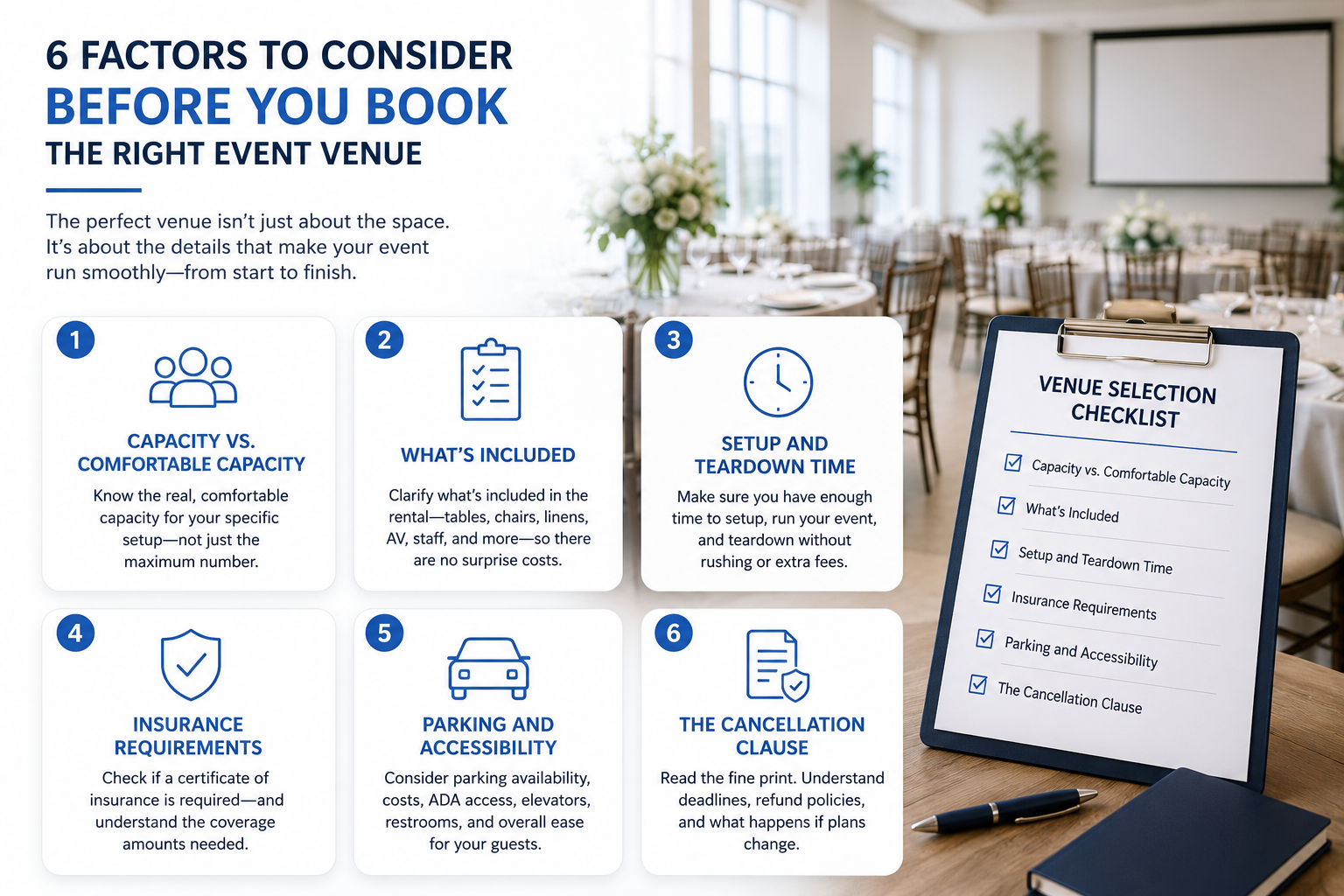 Whether an event venue works for your event comes down to six factors, and price is usually not the one that causes the most trouble. Capacity versus comfortable capacity, what’s actually included, setup and teardown time, insurance requirements, parking and accessibility, and the cancellation clause account for nearly every venue complaint that shows up after the deposit is paid rather than before.
Venue selection is the process event organizers use to match a space’s capacity, cost, and logistics against what an event actually requires, before signing a rental agreement. Start with these six factors rather than price and photos:
- Capacity versus comfortable capacity
- What’s included versus what you’ll need to bring
- Setup and teardown time
- Insurance requirements
- Parking and accessibility
- The cancellation clause
These six apply whether you’re evaluating a fellowship hall, a theatre mainstage, or a park district shelter, though the details differ, which is one reason houses of worship, community theatres, and park districts each handle these questions somewhat differently. For the venue side of this relationship, including how community venues price and structure these rentals, see VenueArc’s guide to facility rental revenue.
Capacity vs. Comfortable Capacity
A venue’s listed capacity and the number of guests it can comfortably hold for your event are usually two different numbers, and the gap between them is where headcounts go wrong.
Listed capacity is often a fire-code maximum: the number of people the room can legally hold standing, shoulder to shoulder, near the exits. A community room rated for 150 standing might seat only 90 comfortably at round tables for a dinner, once you account for a head table, a buffet line, and space to walk between chairs. A theatre’s house capacity assumes fixed seating; it says nothing about a reception built into the same room with a stage or a dance floor.
Ask the venue for the capacity under the specific configuration you’re planning, not the number on the website. If it can’t answer without walking the room with you first, that’s useful information too.
What “Included” Actually Means
“Included” on a venue’s rate sheet almost always covers fewer things than it sounds like, and the gap is where your budget gets a surprise line item two weeks before the event.
Tables and chairs are usually included; linens, place settings, and a sound system for speeches often are not. A theatre space may include house lighting and sound operated by house staff, but not a spotlight operator or extra rehearsal time. A fellowship hall may include kitchen access but not the commercial equipment inside it, and a park district shelter may include picnic tables but not a permit for amplified sound. Public agencies typically publish this level of detail in a standard facility use policy; the National Recreation and Park Association has general guidance on how park agencies structure these policies.
Ask for a written list of what’s included, not a verbal summary during a walkthrough. Then ask what the last few renters had to bring themselves — that question tends to surface the gaps a rate sheet doesn’t mention.
Setup and Teardown Time, and Who Pays for It
Your rental block often covers the hours your event runs, not the hours it takes to set up beforehand or clear out afterward, and that distinction is one of the most common sources of overage fees.
A wedding reception scheduled 5 to 10 p.m. might need caterers and a florist in the room by 2 p.m., and the venue may charge separately for that access, or not allow it without booking an additional block. Teardown works the same way in reverse: a venue with a hard 11 p.m. exit and a security deposit tied to it will charge for every half hour past that time, whether or not the caterer running late was your fault.
Ask whether setup and teardown time is inside your rental block or billed separately, and get the exit time and any penalty in writing.
The Insurance Certificate Nobody Warns You About
Many community venues, especially houses of worship and park districts, require renters to provide a certificate of insurance (COI) before the event, and that requirement is one of the most common reasons an event almost doesn’t happen on schedule.
A COI is proof of general liability insurance, usually naming the venue as an additional insured for the date. If you don’t already carry event or business liability coverage, getting one issued can take several business days, longer if it’s a first-time policy through a one-day event insurance provider. Organizers who find out about the requirement a week out are often scrambling; organizers who ask during the first venue conversation are not.
Ask whether a COI is required, what coverage amount it needs to name, and how far in advance the venue needs it. The Insurance Information Institute publishes a plain-language explainer on general liability and additional-insured coverage if you’ve never arranged one before.
Parking and Accessibility
Parking availability and physical accessibility determine whether your guests can actually get to your event, and both are easy to overlook when you’re evaluating a room instead of the building around it.
Shared parking lots, like a fellowship hall that shares a lot with a school, can fill up fast if another event runs at the same time. Ask whether the lot is dedicated or shared, and whether the venue can reserve spaces for you.
Accessibility means more than a ramp at the front door. Confirm accessible parking, an entrance that isn’t a service door around the back, restrooms on the same floor as your event, and a path to the stage or head table that doesn’t require stairs. The ADA National Network publishes accessibility checklists for event spaces, and VenueArc’s own resource on what renters should be asking about accessibility covers the same ground from the venue operator’s side.
Read the Cancellation Clause Before You Sign
A venue’s cancellation clause determines how much of your deposit you get back and how much notice you owe if plans change, and it’s the section most people skip on the first read.
Look for three things: whether the deposit is refundable, partially refundable, or forfeited if you cancel; how many days’ notice avoids a penalty; and, for outdoor spaces like a park district shelter, what the weather policy actually says. Some venues rebook you automatically to a rain date; others treat a weather cancellation the same as any other one.
If the clause doesn’t answer those three questions clearly, ask the venue and get the answer in writing.
Before you sign
Ask these questions in writing before you pay a deposit so the venue's policies match the event you actually plan to hold.
Talk to a Venue ExpertQuestions That Surface Hidden Costs Before You Book
The fastest way to find a venue’s hidden costs is to ask about them directly, before you sign, rather than discover them on the final invoice. The table below lists the questions worth asking every venue you’re evaluating.
| Question to ask | What it reveals |
|---|---|
| Is setup and teardown time included in my rental block? | Whether you’ll pay overtime for something you assumed was free |
| Do you require a certificate of insurance, and by when? | Whether you need to buy event insurance, and how long that takes to arrange |
| What’s not included that I’ll need to bring or rent myself? | Line items like linens, AV, security, or cleaning that aren’t on the rate sheet |
| What happens if I need to cancel or reschedule? | Whether your deposit is refundable and how much notice you owe |
| Is the quoted capacity a fire-code maximum or a seated capacity? | Whether your actual guest list fits the way you plan to use the room |
| Who handles cleanup, and is there a fee if it’s skipped? | A charge that shows up after the event instead of before it |
None of these questions is unusual to ask, and a venue that can’t answer them clearly is telling you something about how the rest of the process will go.
One honest caveat: this guide covers community venues, the fellowship halls, theatre spaces, and park district facilities that host most local events. If you’re planning a large-scale gala with in-house catering and a dedicated events team, a hotel ballroom or a dedicated event venue built for that scale will likely serve you better than a community space repurposed for it.
A Note for Venues Reading This
If you manage bookings for a house of worship, a community theatre, or a park district facility, you’re likely answering some version of these six questions from every renter, every week. Handing this article out at the first inquiry, alongside a written rate sheet, resolves most of it before it becomes a dispute.
VenueArc’s contract tools generate a rental agreement directly from the booking record, so the cancellation clause and insurance requirement are in writing from the start. Community theatres already using VenueArc to manage outside rental requests run this process the same way for every renter. If you’re comparing platforms, the guide to choosing venue booking software covers the decision criteria, and the ROI breakdown shows whether it pays off at your booking volume.
Frequently Asked Questions
- What size venue do I actually need for my event?
Base it on your actual event layout, not the venue's listed maximum. A seated dinner needs roughly double the square footage per guest that a standing reception does. Ask for capacity under your specific setup, seated, standing, or theatre-style, rather than relying on the website number.
- What's usually included in a venue rental, and what costs extra?
Tables and chairs are commonly included; linens, AV equipment, and kitchen equipment often aren't. Coverage varies by venue type: a theatre may include house lighting but not a spotlight operator, and a park shelter may include tables but not an amplified-sound permit. Always get a written list.
- Do I need a certificate of insurance to rent a venue?
Many houses of worship, community theatres, and park districts require a certificate of insurance naming the venue as an additional insured. If you don't already carry liability coverage, getting one issued can take several business days.
- How far in advance should I book an event venue?
Three to six months ahead is typical for popular dates such as weekends, holidays, and graduation season, and some theatres book a full season in advance. Ask directly, since booking windows vary by venue type.
- What should be in a venue's cancellation policy?
A clear policy states whether the deposit is refundable, partially refundable, or forfeited; how many days' notice avoids a penalty; and, for outdoor venues, the weather rescheduling terms. If a contract doesn't spell these out, ask for the answers in writing before you sign.
- Where can I find an accessible, affordable venue for a community event?
Houses of worship, community theatres, and park district facilities are typically the most affordable options for community events and are often reasonably accessible, though this varies building to building. Confirm accessible parking, entrances, and restrooms directly with each venue.
Ready to simplify your venue operations?
See how VenueArc helps venue teams coordinate bookings, approvals, documents, and settlement without routine operational chaos.