venue management
Event Management Technology Trends Reshaping Venues in 2026
Explore the technology trends reshaping venue operations in 2026, from AI-powered inquiry automation to governance-first workflows and analytics-driven scheduling.
IN THIS ARTICLE
The most important venue technology trend in 2026 is not artificial intelligence alone. It is the shift from disconnected tools to operational systems that connect inquiry management, approvals, contracts, scheduling, payments, and reporting in one place. AI is accelerating that change, but venues that automate broken processes are discovering that faster chaos is still chaos.
This guide is for houses of worship, community theatres, and park districts that want to understand which technology trends are actually changing venue operations and which trends are mostly marketing noise. By the end, you will know which innovations deserve attention now and which ones can wait.
What Counts as Next Generation Event Technology in 2026?
Next generation event technology is software and automation that reduces operational friction across the full event lifecycle, from inquiry and booking through contracts, event execution, settlement, and reporting.
For community venues, the biggest changes are not flashy AI features. The most meaningful improvements come from eliminating manual handoffs and creating a single source of truth across departments.
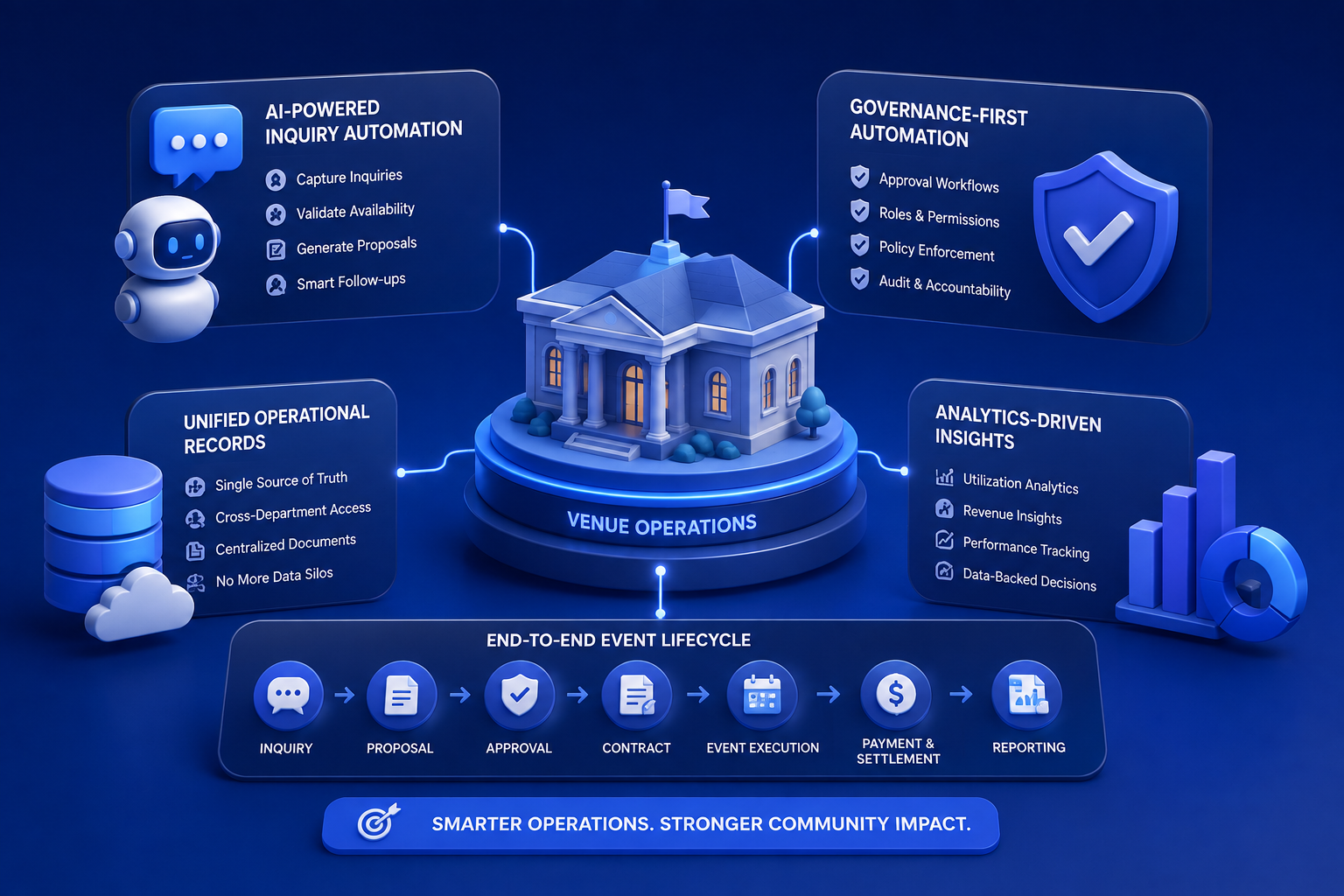
The Five Technology Forces Reshaping Venue Operations
| Trend | Primary Impact |
|---|---|
| AI-powered inquiry automation | Faster inquiry handling and draft proposal generation |
| Governance-first automation | Clear approval workflows and accountability |
| Unified operational records | Reduced data silos and information loss |
| Analytics-driven facility management | Better utilization and planning decisions |
| Vertical SaaS specialization | Better alignment with venue-specific workflows |
Trend 1: AI-Powered Inquiry Automation Is Replacing Manual Intake
AI-powered inquiry automation is transforming how venues process booking requests by helping staff gather information, validate availability, categorize requests, and generate proposals.
Many community venues still start every booking through an email inbox. Someone manually checks availability, forwards requests, gathers additional information, and prepares a proposal.
Modern venue software increasingly supports:
- Automated inquiry routing
- Proposal preparation assistance
- Availability validation
- Intake form processing
- Request categorization
- Follow-up reminders
For example, a park district can automatically route shelter reservations differently than athletic field requests. A community theatre can distinguish rehearsal requests from performance rentals.
The Important Limitation
Automation helps only when approval processes already exist.
If nobody knows who has authority to approve a rental, automation simply moves confusion faster.
Community venues often discover that approval structure is a larger problem than response time.
Trend 2: Governance-First Automation Is More Important Than AI
Governance-first automation means establishing rules, permissions, workflows, and approval paths before technology automates them.
This is one of the most important trends affecting venue operations in 2026.
Technology vendors often focus on speed.
Successful venues focus on accountability.
Consider a recurring Wednesday ministry meeting at a house of worship:
- Who approves external rentals?
- Who can override the booking?
- Who manages holiday exceptions?
- Who edits recurring schedules?
- Who approves contracts?
Before automation generates value, these questions require answers.
Governance Checklist
Before implementing automation, venues should define:
- Booking approval authority
- Contract approval authority
- Financial reporting access
- Calendar ownership
- Exception handling procedures
- Permission levels across staff and volunteers
Organizations that define governance first typically experience smoother technology adoption.
Need help evaluating your workflow?
If your team is comparing booking tools, the most useful next step is a workflow-specific demo based on your actual requests, holds, and approval rules.
Book a DemoTrend 3: Unified Operational Records Are Replacing Disconnected Systems
Unified operational platforms connect booking data, contracts, client information, documents, payments, and reporting into one record.
Many venues continue using separate systems for each process.
| Process | Traditional Method | Unified Method |
|---|---|---|
| Booking | Spreadsheet | Central booking record |
| Contracts | Email attachment | Connected contract record |
| Payments | Finance sheet | Integrated tracking |
| Event files | Shared folders | Document center |
| Reporting | Manual compilation | Automated reports |
Disconnected systems create information gaps.
One staff member may know setup requirements.
Another may know client information.
A third may manage payments.
When these records remain disconnected, operational mistakes become common.
The future of venue technology is not creating more systems.
It is connecting existing workflows.
Trend 4: Analytics-Driven Facility Management Is Becoming Standard
Analytics-driven venue management uses operational data to improve scheduling, revenue generation, utilization, and strategic planning.
Historically, many community venues relied on intuition.
Today, venue operators increasingly ask:
- Which rooms are underutilized?
- Which rentals generate the most revenue?
- Which recurring bookings consume valuable capacity?
- Which facilities justify expansion?
These questions require data.
Metrics That Matter
The most useful metrics often include:
- Space utilization
- Booking lead time
- Revenue by facility
- Event category distribution
- Outstanding balances
- Rental conversion rates
The objective is not producing dashboards.
The objective is making better decisions.
A facility that appears busy may actually generate very little rental revenue.
Analytics reveal those differences.
Trend 5: Vertical SaaS Is Winning Over Generic Software
Vertical SaaS platforms serve specific industries rather than broad business categories.
This trend is accelerating because venue operations contain highly specialized workflows.
Community Theatres Need
- Performance holds
- Rehearsal scheduling
- Load-in periods
- Strike windows
- Settlement reporting
Houses of Worship Need
- Ministry scheduling
- Volunteer access controls
- Multi-campus visibility
- Sanctuary reservations
- External rental management
Park Districts Need
- Permit tracking
- Resident pricing structures
- Public transparency
- Field allocation
- Fair-access policies
Generic tools often manage calendars successfully.
They rarely manage industry-specific operational requirements.
Why Specialization Matters
The important question is no longer:
“Can this software manage bookings?”
The real question is:
“Can this software manage bookings the way our organization actually operates?”
Purpose-built venue software increasingly outperforms generic scheduling tools because it understands the operational realities of community venues.
Which Technology Investments Should Venues Prioritize?
Not every venue requires every new technology.
Investment priorities should align with operational challenges.
| Challenge | Priority Investment |
|---|---|
| Double bookings | Booking management software |
| Approval delays | Workflow automation |
| Lost documents | Document management |
| Lack of visibility | Reporting and analytics |
| Heavy email dependence | Inquiry automation |
| Multi-location complexity | Centralized scheduling |
The best technology investment is the one that solves your biggest operational bottleneck.
When These Trends May Not Matter
Technology should match organizational complexity.
A small venue with very low booking volume may not need advanced automation.
Likewise, a space that rarely processes external rentals may gain minimal value from sophisticated workflows.
Technology investments create value only when operational complexity justifies them.
For some organizations, simplicity remains the correct answer.
Decision Point
The most successful venues in 2026 are not adopting every emerging technology trend.
They are identifying which operational bottlenecks actually constrain growth and then selecting technology that fixes the cause rather than the symptom.
For most venues, the winning approach is not AI for AI’s sake. It is connected systems, governance, better reporting, and workflows designed around the way the venue actually operates.
That is where the next generation of venue technology is already creating value. Explore VenueArc event management software
Frequently Asked Questions
- Which event management technology trend is having the biggest impact in 2026?
AI-powered inquiry automation gets the most attention, but governance-first automation is creating the most practical impact because it reduces approval bottlenecks and makes workflows more accountable.
- What is the most important technology for preventing double bookings?
A centralized booking platform with booking states, approval workflows, conflict detection, and recurring scheduling is the most effective way to eliminate double bookings.
- Which software supports both venue rental management and event space booking?
Purpose-built venue management platforms usually combine booking management, contracts, documents, payment tracking, and reporting in one operational system so teams do not have to rely on disconnected tools.
- Are AI booking assistants replacing venue staff?
No. AI tools generally support venue staff by organizing inquiries, drafting responses, gathering information, and routing requests. Human oversight remains essential for approvals and operational decisions.
- What technology trend matters most for houses of worship?
Multi-campus visibility, volunteer permissions, and governance structures are increasingly important for houses of worship managing ministries, rentals, and recurring events across multiple spaces.
- What technology trend matters most for community theatres?
Integrated scheduling across rehearsals, productions, rentals, load-ins, strike periods, and settlements continues to be one of the biggest operational improvements available.
Ready to simplify your venue operations?
See how VenueArc helps venue teams coordinate bookings, approvals, documents, and settlement without routine operational chaos.